
To effectively communicate with a parent who has dementia, you must avoid arguing or correcting their reality. Instead, use simple, short sentences, maintain reassuring eye contact, and practice “Validation Therapy” by acknowledging the emotions behind their words. Avoid asking open-ended questions that rely on short-term memory, and redirect their attention with a calm, positive tone when they become agitated.
The Hardest Transition: Changing How You Talk
Alzheimer’s disease and other forms of dementia don’t just steal memories; they steal the ability to process language, logic, and reasoning.
For adult children, this is often the most agonizing part of the disease. The parent who used to give you brilliant advice can suddenly no longer follow a basic conversation or insists that a deceased relative is coming over for dinner. Our natural instinct is to correct them, to orient them to “our” reality.
“Mom, Dad died ten years ago, remember?”
But with dementia, logic no longer works. Correcting them only leads to fear, agitation, and heartbreak for both of you. To communicate effectively with a parent who has dementia in Southwest Florida, you have to learn a new language. You have to learn how to speak to their emotions, rather than their intellect.
Here are 7 expert strategies used by the memory care professionals at Shal We Home Care.
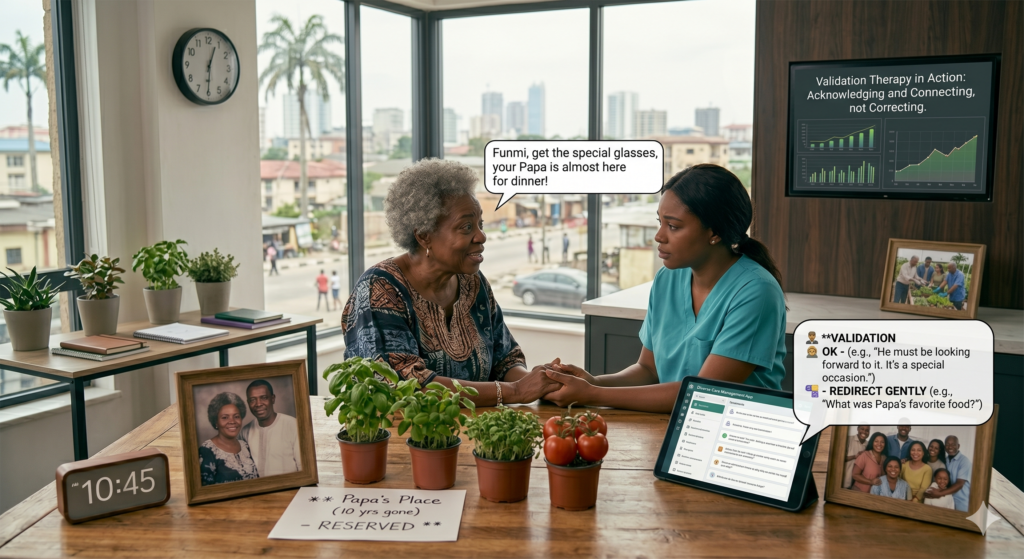
Rule 1: Never Argue or Correct
This is the golden rule of dementia care. If your father insists it is 1985 and he needs to get to work, telling him he is 85 years old and retired will only make him angry. His brain is telling him it is 1985, and to him, that is an absolute fact.
- The Shift: Let go of the need to be “right.” Winning an argument with someone who has dementia means you both lose. Agree, apologize if they are upset, and move on.

Rule 2: Enter Their Reality (Validation Therapy)
Instead of dragging them into your reality, you must bravely step into theirs. This is known as Validation Therapy. It involves listening to the emotion behind their words, rather than the literal meaning.
- Scenario: Your mother is crying, looking for her own mother (who passed away decades ago).
- Do Not Say: “Your mother is dead.” (This will force her to relive the grief of her mother’s death all over again as if it just happened).
- Say This: “You miss your mom, don’t you? She was a wonderful lady. Tell me about your favorite thing she used to bake.”
- Why it works: You validated her feeling (missing her mom) and comforted her, without forcing a painful truth upon a broken brain.

Rule 3: Simplify Your Language
As dementia progresses, the brain struggles to process complex, multi-step sentences.
- Do Not Say: “Dad, go into the bedroom, grab your blue sweater out of the closet, and then meet me in the kitchen so we can go to the doctor.” (Too many steps).
- Say This: “Dad, let’s go to the bedroom.” (Wait until you are there). “Here is your sweater. Put this on.” (Wait). “Great. Let’s go to the car.”
- Tip: Speak slowly, clearly, and in a lower pitch (which is easier for aging ears to hear). Give them at least 10 seconds to process what you said before repeating it.

Rule 4: Avoid Memory-Testing Questions
Asking someone with dementia to remember something puts them on the spot, causing immense anxiety when they realize their brain is failing them.
- Do Not Say: “Do you remember what you had for breakfast?” or “Do you know who came to visit you today?”
- Say This: “It looked like you enjoyed your eggs this morning!” or “It was so nice to see Cousin Sarah today.”
- The Shift: Give them the information rather than asking them to retrieve it.
Rule 5: Use The “Redirection” Technique
If your parent is stuck on an anxious loop or a delusion (e.g., “Someone stole my purse!”), you cannot reason them out of it. You must redirect their attention.
- Acknowledge, then Pivot: “Oh no, your purse is missing? Let’s look for it together. Oh, look at this old photo album I found while looking! Who is this in the picture?”
- Why it works: Dementia severely impacts short-term memory. If you can successfully distract them with something pleasant, they will often forget why they were upset in the first place within a few minutes.
Rule 6: Pay Attention to Non-Verbal Cues
Experts say that in late-stage dementia, up to 90% of communication is non-verbal. Your parent is reading your body language, your facial expressions, and the tone of your voice far more than the words you are saying.
- Body Language: Approach them from the front (never startle them from behind). Get down on their eye level. Do not stand over them, which can feel intimidating.
- Your Energy: If you are stressed and rushing, they will mirror your anxiety and become agitated. You must project calm, even if you are frustrated. Keep a soft smile and use gentle touch (like holding their hand) if it comforts them.
Rule 7: Hire Specialized Support When Needed
Communicating using these techniques takes immense emotional energy and extreme patience. For a family caregiver doing it 24/7, it is exhausting.
At Shal We Home Care, our caregivers are trained specifically in dementia communication protocols.
- We bring a fresh wave of patience to the home.
- Because we do not carry the emotional history of being the daughter or son, we can remain entirely objective and calm during difficult moments.
- We provide the respite you need to step away, recharge, and return to your parent with the emotional bandwidth required to connect with them joyfully.
Key Takeaways
- Join Their World: Don’t argue with delusions. Validate their feelings and step into their reality.
- Keep it Simple: Use short sentences and give one instruction at a time.
- Don’t Quiz: Avoid questions that rely on short-term memory.
- Redirect: Use a calm, positive distraction to break anxious mental loops.
- Watch Your Energy: Your loved one will mirror your stress; approach them with a calm, unhurried demeanor.
Is dementia communication straining your relationship?
You don’t have to navigate memory loss alone. Contact Shal We Home Care in Lee, Collier, and Hendry counties today. Let our specialized dementia caregivers bring peace, patience, and effective communication back to your home.