
Struggling with toileting for an older autistic child? Discover the biological and sensory barriers to potty training and learn compassionate, visual strategies for success.
Toileting challenges in older autistic children are rarely behavioral; they are typically rooted in severe sensory aversions (fear of the loud flush or cold seats) or a lack of interoception (the inability to feel the internal bodily urge to go). To achieve toileting success, parents must remove all sensory threats from the bathroom, implement strict visual schedules to make the process predictable, utilize timed voiding (taking the child to the bathroom every 60-90 minutes regardless of their perceived need), and completely remove pressure or punishment from the routine.
In the neurotypical world, potty training is a milestone usually achieved by age three or four. Parents celebrate it, post about it, and move on.
In the neurodivergent world, toileting is often a massive, multi-year hurdle. It is incredibly common for children with severe Autism Spectrum Disorder (ASD) or intellectual disabilities to struggle with toileting well into their elementary, middle school, or even teenage years.
Because of the intense societal stigma attached to older children wearing pull-ups or diapers, parents suffer in silence. They don’t talk to other parents at the playground about it. They avoid family vacations or long outings because changing a 10-year-old in a public restroom is a logistical nightmare.
If you are a parent in Southwest Florida dealing with this, you must hear this: You have not failed. Your child is not being “stubborn” or “lazy.” Toileting is one of the most complex neurological and sensory tasks a human being performs. Here is a clinical, compassionate breakdown of why it is so difficult and how to approach it.
Traditional potty training relies on two things: verbal instruction and social pressure (e.g., “Big boys use the potty!”).
For an autistic brain, both of these methods are ineffective. An autistic child with language delays may not comprehend the verbal instructions. Furthermore, many autistic children are not driven by social conformity. They don’t care if a peer uses the toilet; they care about their own internal comfort. Wearing a familiar, warm pull-up is comfortable and predictable. The toilet is cold, loud, and unpredictable.
Before you can use a toilet, you have to know that your bladder or bowel is full. This relies on the “eighth sensory system” known as interoception.
Interoception is how the brain perceives signals from inside the body (hunger, thirst, pain, needing to pee). In many autistic individuals, the interoceptive system is severely delayed or completely broken.
- The Reality: Your child literally cannot feel that their bladder is full until the exact second it begins to empty. They aren’t ignoring the urge; the urge isn’t registering in their brain.
- The Fix: You cannot rely on them telling you they need to go. You must implement strict timed voiding (discussed below).
To an individual with sensory processing disorder (SPD), the bathroom is a sensory house of horrors. Evaluate the bathroom through their eyes and ears:
- Auditory Assault: The sudden, roaring sound of a toilet flushing or the jet-engine scream of a public hand dryer causes physical pain to their ears.
- Tactile Shock: Sitting on a hard, freezing cold toilet seat is a massive tactile shock that causes their muscles to instantly tense up, making it biologically impossible to relax the sphincter and go to the bathroom.
- Visual Fear: The water swirling down a hole can look like a terrifying void. Some children fear they will be sucked down into it.
- Proprioceptive Fear: Sitting on a high toilet with their feet dangling in the air makes them feel unstable. They feel like they are falling.
Before you ask them to use the toilet, you must make the bathroom a safe space.
- Fix the Posture: A child cannot use the bathroom if their feet are dangling. They need to bear down. Buy a sturdy step stool (like a Squatty Potty) so your feet are planted firmly. Use a cushioned insert so the hole doesn’t feel so large or cold.
- Remove the Noise: Warn them before you flush or allow them to leave the room before the toilet is flushed. In public restrooms, put a post-it note over the automatic flush sensor so it doesn’t trigger unexpectedly and terrify them.
- Change the Lighting: Turn off the harsh, buzzing fluorescent lights. Use a warm, soft lamp.
Because verbal commands and internal urges fail, you must rely on visual routines and alarms.
- Timed Voiding: Set a digital alarm for every 60 to 90 minutes. When the alarm goes off, it is “Potty Time.” Do not ask, “Do you have to go?” State neutrally, “The alarm rang. It is time to sit on the potty. “Even if they just sit there for 2 minutes and do nothing, praise them for following the routine.
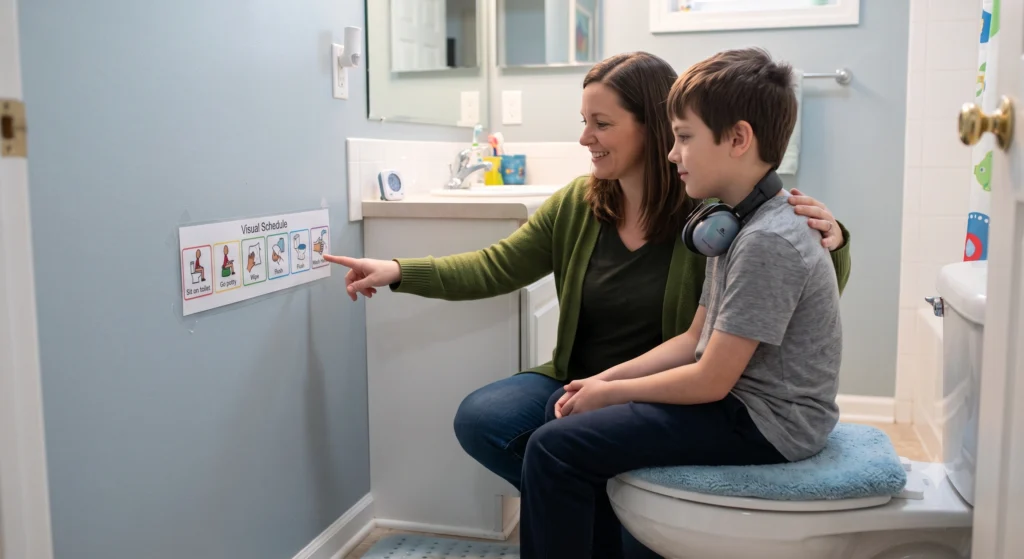
- Visual Schedules: Create a laminated, step-by-step visual chart taped at eye level next to the toilet. 1. Pull down pants. 2. Sit down. 3. Use toilet paper. 4. Pull up pants. 5. Wash hands. This removes the anxiety of having to remember the complex motor steps.
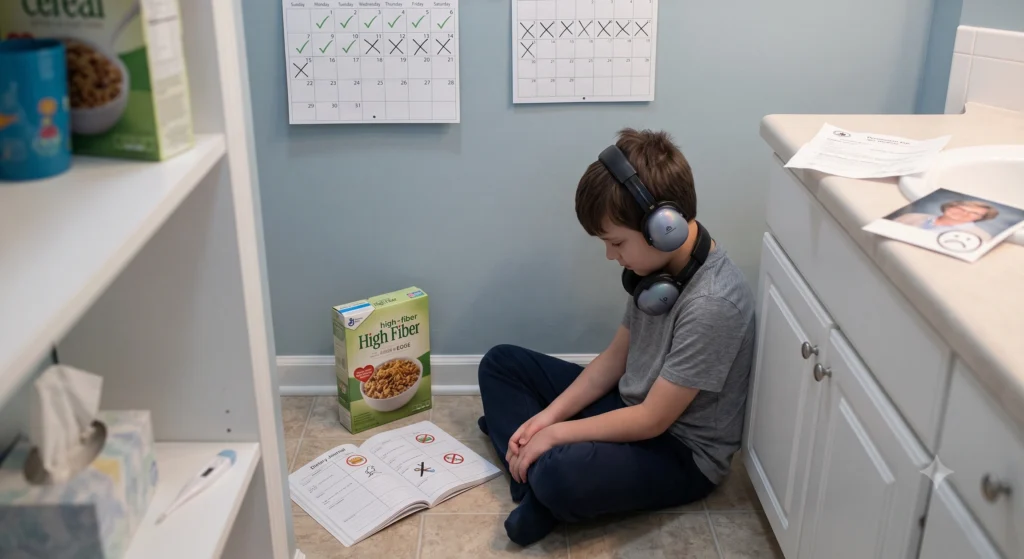
Regression is a hallmark of autism. Your child may have a perfect month of toileting, and then suddenly begin having accidents every day. Regression usually means there is a hidden stressor. Are they sick? Is there a new teacher at school? Is there a change in their diet causing painful constipation?
Never punish or shame them for an accident. Shame elevates cortisol (anxiety), making them want to avoid the bathroom entirely. If they have an accident, maintain a completely flat, neutral affect. Clean it up calmly and say, “Your body had an accident. Next time we will try the toilet.” Keep the emotional temperature at zero.
Cleaning up accidents for an older child or teenager is physically exhausting and emotionally draining for parents. It frequently leads to severe caregiver burnout.
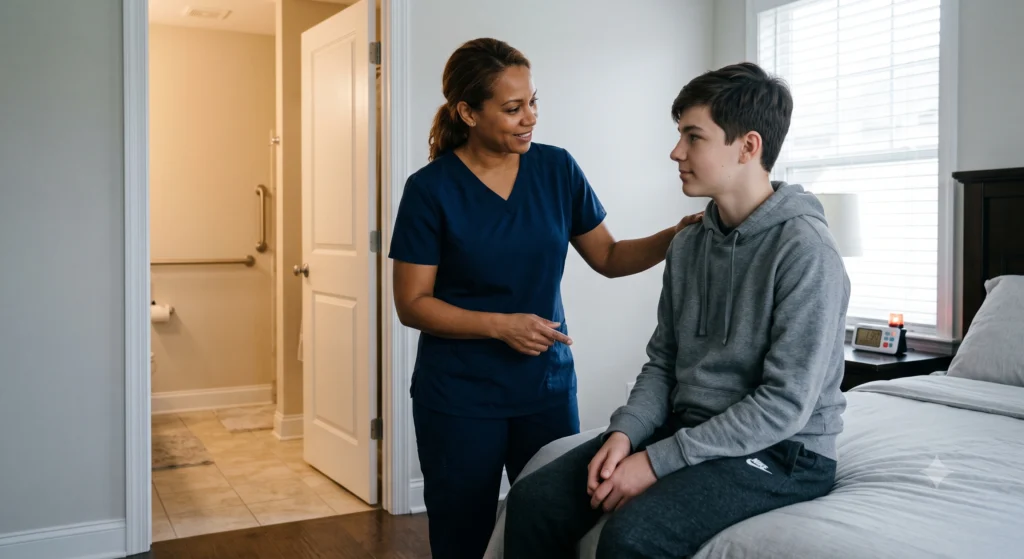
At Shal We Home Care, serving Lee, Collier, and Hendry counties, we provide specialized caregivers who are trained to handle hygiene care with absolute clinical dignity.
- We Maintain the Routine: When we provide respite care, we strictly follow your timed voiding schedule and visual charts, ensuring consistency when you aren’t there.
- We Absorb the Stress: Our professionals handle bathroom accidents objectively, removing the emotional friction between parent and child.
- You Get a Break: Allowing us to manage the complex hygiene routines gives you the physical and mental break required to be a patient, loving parent the rest of the week.
- It’s Biology, Not Behavior: Understand that broken interoception (not feeling the urge) and sensory overload are the root causes, not defiance.
- Fix the Physics: Ensure their feet are firmly planted on a stool and the seat is comfortable so they feel secure.
- Mute the Flush: Protect them from the terrifying sounds of flushing and hand dryers.
- Use Timed Alarms: Don’t wait for them to tell you; take them to the bathroom on a strict 90-minute schedule.
- Stay Neutral: Never shame or yell during an accident; keep the emotional response completely flat.
Is toileting causing severe stress in your household? You do not have to carry this heavy burden alone.
Contact Shal We Home Care today. Let our specialized special needs caregivers provide the support and routine maintenance your family needs in Southwest Florida.