
Florida IEP meetings can be incredibly intimidating. Learn how to advocate for your autistic child, prepare your “Brag Sheet,” and secure vital school accommodations.
To successfully navigate an Individualized Education Program (IEP) meeting in Florida, parents must shift from an emotional mindset to a business mindset. Key strategies include recording the meeting (with prior notice), building a “Parent Brag Sheet” to highlight the child’s strengths, demanding SMART (Specific, Measurable, Achievable, Relevant, Time-bound) goals, and bringing a professional advocate or private caregiver to the meeting to ensure the school district complies with federal IDEA mandates.
If you are raising a neurodivergent child in Southwest Florida, there are few days on the calendar more stressful than the annual IEP (Individualized Education Program) meeting.
You walk into a sterile school conference room. Sitting across the table from you are the principal, the ESE (Exceptional Student Education) coordinator, the school psychologist, the speech therapist, and the general education teacher. It feels like a tribunal.
Too often, these professionals speak in a dizzying flurry of acronyms, quickly slide a 30-page document across the desk, and ask you to sign it. Because parents feel outnumbered and overwhelmed, they sign it, only to realize later that their child’s vital speech therapy hours were cut or that their request for a 1-on-1 paraprofessional was ignored.
You are not just a parent at an IEP meeting; you are the CEO of your child’s education. You have federal rights under the IDEA (Individuals with Disabilities Education Act). Here is your master guide to preparing, advocating, and winning at the Florida IEP table.
Before entering the meeting, you must know what legal framework protects your child.
- The 504 Plan: This falls under the Rehabilitation Act. It simply levels the playing field. It provides accommodations (like extra time on tests or permission to use fidget toys) for a child in a standard classroom. It does not change what the child is learning.
- The IEP (Individualized Education Program): This is a binding, federal legal contract under IDEA. It is for children who require specialized instruction. It dictates exactly what services the school must provide (speech, occupational therapy, behavior plans) and provides specific, legally binding educational goals. If your child has moderate to severe autism, they need an IEP.
Do not walk into an IEP meeting empty-handed. Schools focus heavily on deficits, what the child cannot do. You must remind the room that your child is a whole person.
Create a one-page “Parent Brag Sheet” and distribute it to everyone at the table. Include:
- Strengths: “Loves building complex Lego structures, has an incredible memory for dates, is deeply empathetic to animals.”
- Triggers: “Fluorescent lights cause migraines; unstructured recess causes severe anxiety.”
- What Works at Home: “Using a visual timer for transitions; offering a crunchy snack when frustrated.”
- Your Goals: “I want him to be able to order his own lunch in the cafeteria this year.”
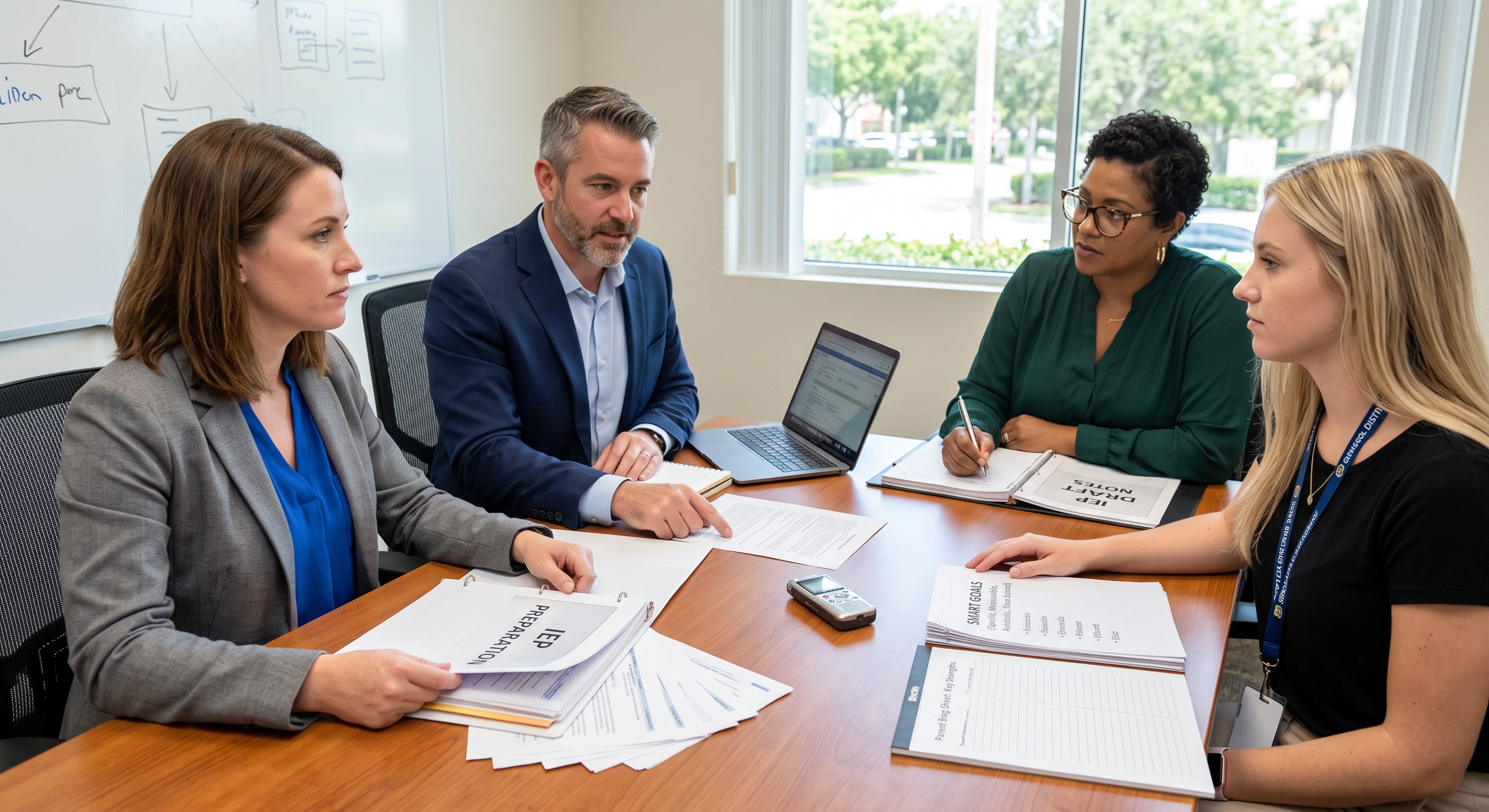
This document humanizes your child and forces the staff to see their potential, not just their diagnosis.
You must remove your emotions from the table. If you cry or yell, the school staff will dismiss you as an “overly emotional parent.”
- Record the Meeting: Under Florida law, you have the right to audio record an IEP meeting, but you must inform the school in writing at least 24 hours in advance. Recording the meeting entirely changes the dynamic. Staff will be far more careful about what they promise and what they deny when they know they are on the record.
- Never Sign the IEP That Day: The school will push you to sign the document at the end of the hour. Do not sign it. Tell them, “Thank you for your hard work. I am going to take this home, review it with my spouse/advocate, and I will return it within 3 days.” This gives you time to find the hidden cuts in services.
An IEP is useless if the goals are vague. A school might write a goal that says, “Johnny will improve his social skills and decrease his meltdowns.”
This is legally unenforceable. You cannot measure “improve.” You must demand S.M.A.R.T. goals (Specific, Measurable, Achievable, Relevant, Time-bound).
- Bad Goal: “Johnny will ask for a break.”
- SMART Goal: “By May 2025, when feeling overwhelmed, Johnny will independently use his AAC device to request a sensory break in 4 out of 5 observed opportunities, across 3 different classroom settings, as measured by teacher data tracking.”
If the goal isn’t measurable with hard data, demand they rewrite it.
The most common phrase parents hear in Lee and Collier County schools is, “We would love to give him 1-on-1 speech therapy, but the district just doesn’t have the funding or staff for that.”
The Legal Rebuttal: Under the IDEA, a school district’s lack of funding or staff is entirely irrelevant to your child’s IEP.
The IEP must be based exclusively on the needs of the child, not the budget of the district. If your child requires 1-on-1 therapy to access a Free Appropriate Public Education (FAPE), the school must provide it. If they don’t have the staff, they are legally required to hire a private contractor or pay for your child to receive the therapy outside of school. Stand your ground.
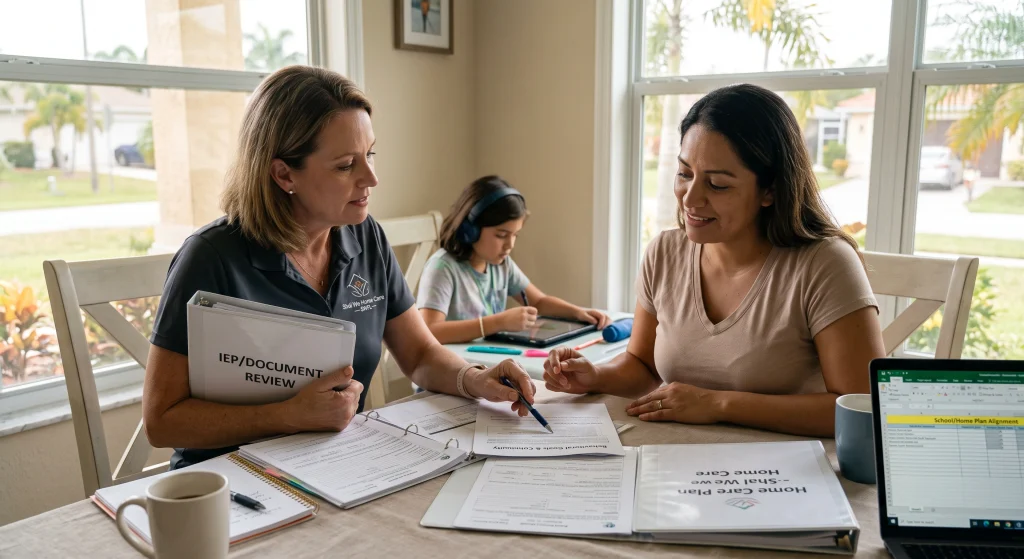
What happens at school must be reinforced at home, or the child will regress.
At Shal We Home Care, we partner with parents in Southwest Florida to ensure continuity of care.
- The Meeting Advocate: As part of our comprehensive family support, our experienced care managers can act as an objective, professional set of eyes and ears, helping you review IEP documents and ensuring the home care plan aligns perfectly with the school’s behavioral goals.
- After-School Consistency: When our respite caregivers arrive at your home at 3:00 PM, we don’t just act as babysitters. We implement the exact same visual schedules, communication tools, and behavioral protocols used in the IEP, ensuring your child experiences a seamless, anxiety-free transition from school to home.
- You Are the CEO: Do not let a room full of professionals intimidate you; nobody knows your child better than you do.
- Bring a Brag Sheet: Start the meeting by focusing on your child’s strengths and what strategies work best at home.
- Record and Delay: Notify the school you will be recording the meeting, and never sign the IEP on the same day. Take it home to review.
- Demand SMART Goals: Refuse vague goals; ensure every metric is specific, data-driven, and time-bound.
- Funding is Not an Excuse: Federal law dictates that IEP services are based on the child’s needs, not the school district’s budget limitations.
Are you overwhelmed by the fight for your child’s education? You don’t have to navigate the special needs journey alone.
Contact Shal We Home Care today. Let our team provide the consistent, specialized after-school support your child needs to thrive in Southwest Florida.