
Did your elderly parent suddenly develop severe dementia symptoms overnight? Before panicking, check for a Urinary Tract Infection (UTI). Learn the subtle signs and dangers.
When a senior suddenly experiences severe confusion, delirium, hallucinations, or a sudden loss of mobility, the cause is frequently a Urinary Tract Infection (UTI), not sudden-onset dementia. Unlike younger adults, seniors often do not experience typical UTI symptoms like pain or burning. Instead, the infection manifests as severe cognitive and behavioral changes. Caregivers must seek immediate medical testing (a urinalysis) when sudden mental changes occur, as an untreated UTI can quickly lead to fatal sepsis.

It is a terrifying scenario that plays out weekly in households across Southwest Florida:
On Tuesday, your 80-year-old mother is her usual self sharp, conversational, and enjoying her afternoon crossword puzzle. By Thursday morning, everything has changed. She doesn’t know where she is. She is agitated, speaking nonsensically, hallucinating that there are people in her living room, and is too weak to stand up.
Panic sets in. Families immediately assume the worst: a massive stroke, or a sudden, catastrophic onset of severe Alzheimer’s disease. They rush her to the emergency room at Lee Memorial or NCH, fearing she will never be the same again.
However, the culprit is often much smaller, much more common, and completely curable: A Urinary Tract Infection (UTI).
Understanding the bizarre and deeply hidden link between a simple bladder infection and severe cognitive delirium is one of the most important pieces of medical knowledge a family caregiver can possess.
If you are a 30-year-old and you get a UTI, your body sends very clear, undeniable signals. You experience a burning sensation when urinating, pelvic pain, and a constant, urgent need to use the bathroom.

Seniors rarely experience these classic symptoms.
As the human body ages, the immune system’s response changes. Furthermore, aging nerves may not transmit pain signals as sharply as they used to. Therefore, the burning and pain are completely absent. Because there is no physical pain, the senior does not complain, and the infection goes entirely unnoticed by the family until it breaches the bloodstream.
If there is no pain, why does the senior suddenly act like they have advanced dementia?
The condition is known as Delirium a state of acute, severe confusion. When a UTI goes untreated in an older adult, the infection creates systemic stress on the body. The aging brain is incredibly fragile and highly sensitive to any systemic infection, inflammation, or drop in blood oxygen levels. The infection breaches the blood-brain barrier with inflammation, essentially causing the brain’s cognitive functions to “short circuit.”
The good news? Once the senior is given a course of antibiotics and IV fluids, the “dementia” often vanishes as quickly as it appeared, usually within 24 to 48 hours.

Because you cannot rely on your parent to tell you it “hurts when they go to the bathroom,” you must become a behavioral detective. Watch for these sudden, uncharacteristic red flags:
- Sudden Confusion or Hallucinations: A rapid (within 24-48 hours) change in mental status.
- Extreme Lethargy: Sleeping all day, an inability to stay awake, or staring blankly at the wall.
- New Incontinence: If your parent has always made it to the toilet but suddenly begins having “accidents” or wetting the bed.
- Loss of Mobility / Sudden Falls: An unexplained drop in physical strength. If they could walk yesterday but cannot bear weight on their legs today.
- Behavioral Changes: Sudden, uncharacteristic anger, paranoia, or crying.
- Dark or Odorous Urine: This is the one physical clue. If the bathroom smells unusually strong, or the urine is dark/cloudy, it is a massive warning sign.

The lack of classic symptoms makes UTIs incredibly dangerous because they are frequently misdiagnosed, even by medical professionals who do not specialize in geriatrics.
If an elderly patient is brought to the ER exhibiting severe confusion and combativeness, an overworked doctor might assume it is natural dementia progression. They may prescribe an anti-psychotic or a sedative to calm the senior down and send them home.
If this happens, the untreated UTI will continue to spread, eventually moving into the kidneys and bloodstream, causing Sepsis. Sepsis is a life-threatening medical emergency with a high mortality rate in seniors.
Your Role as Advocate: If your parent experiences sudden confusion, you must explicitly demand a urinalysis. Tell the doctor: “This is a sudden, 24-hour change in her cognition. I want her urine tested for a UTI immediately.”

Preventing a UTI is far easier than treating the delirium it causes. In the hot climate of Southwest Florida, prevention relies heavily on hydration and hygiene.
- Aggressive Hydration: Dehydration concentrates the urine, allowing bacteria to multiply rapidly. (See our guide on Dehydration for creative ways to increase fluid intake).
- Proper Hygiene: For seniors who struggle with mobility or obesity, reaching around to wipe properly after using the toilet becomes physically impossible, leading to bacterial cross-contamination.
- Incontinence Care: Adult briefs (diapers) must be changed immediately when soiled. Sitting in a wet or soiled brief creates a perfect, warm environment for bacteria to travel up the urethra.
- Cranberry Supplements: While not a cure, daily cranberry extract supplements can make the bladder wall “slippery,” making it harder for bacteria to attach.
For adult children, assisting a parent with wiping or checking the color of their urine is uncomfortable and crosses a dignity boundary.
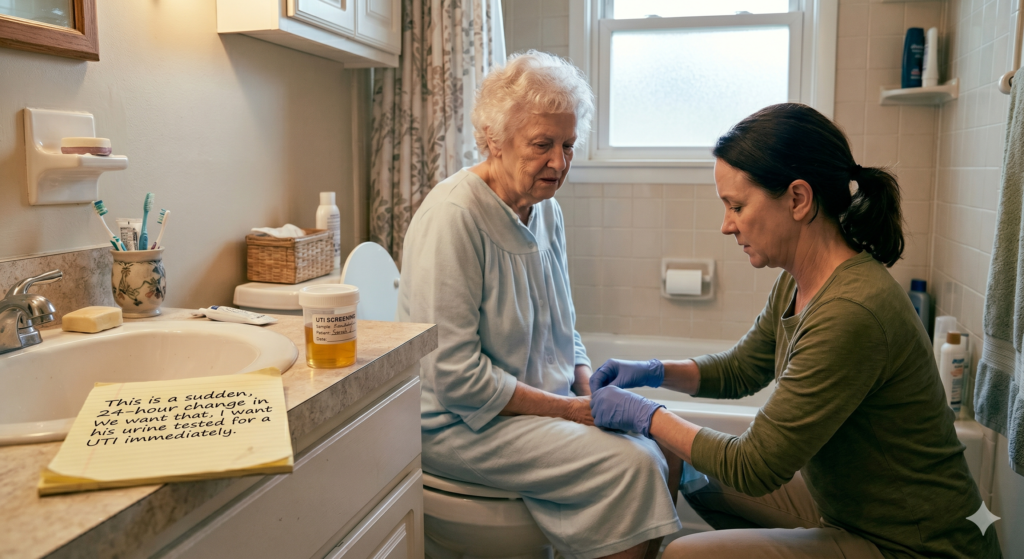
At Shal We Home Care, our professional caregivers handle these intimate tasks with clinical objectivity and total respect.
- Hygiene Management: We ensure proper, sanitary wiping techniques are used and that adult briefs are changed promptly and the skin is thoroughly cleaned.
- Hydration Tracking: We monitor fluid intake throughout the day to ensure the bladder is constantly being flushed.
- The First Alert: Because our caregivers spend hours with your loved one, we are usually the first to notice the subtle signs of delirium. If Mom seems slightly more confused than she was yesterday, or if the bathroom has a new odor, our caregivers alert the family immediately, catching the UTI days before it requires a hospital trip.
- UTIs Mimic Dementia: Sudden, severe confusion or hallucinations overnight are classic signs of a UTI in the elderly, not Alzheimer’s.
- No Pain, Big Problem: Seniors rarely experience the burning or pain associated with UTIs in younger adults.
- Demand a Test: Always demand a urinalysis at the doctor or ER if your parent exhibits sudden behavioral or mobility changes.
- Hydration is Prevention: Forcing fluids is the best way to prevent bacteria from multiplying in the bladder.
- Professional Hygiene: Utilize professional home caregivers to ensure sanitary toileting practices and prompt incontinence care to prevent infections.
Has your loved one’s behavior suddenly changed? Don’t wait for a crisis. Seek medical attention, and then contact Shal We Home Care to ensure their daily hygiene and hydration routines are properly managed to prevent future infections.