
Siblings of children with severe autism often suffer in silence as “glass children.” Learn how to balance attention, validate their feelings, and use respite care to reconnect.
Neurotypical siblings in special needs homes are often referred to as “glass children” because parents, overwhelmed by medical and behavioral crises, inadvertently look right through their needs. To support these siblings, parents must actively schedule non-negotiable 1-on-1 time, validate their feelings of resentment or guilt without judgment, avoid forcing them into a “third parent” caregiving role, and utilize professional respite care to free up the time necessary to nurture the sibling relationship.

In a household raising a child with severe Autism Spectrum Disorder (ASD) or profound physical disabilities, the center of gravity shifts entirely to survival. The days are dictated by therapy schedules, administering medications, managing explosive sensory meltdowns, and fighting for basic educational accommodations.
But what happens to the other children in the house?
In the special needs community, neurotypical siblings are increasingly referring to themselves as “glass children.” They are named this not because they are fragile, but because they feel their exhausted parents look right through them in order to focus on the child in crisis.
If you are a parent in Southwest Florida raising both a neurodivergent and a neurotypical child, you are likely carrying a massive amount of guilt regarding this exact dynamic. You know you are missing your daughter’s soccer games because your son cannot handle the sensory environment of the field. You know you are exhausted when your typical child asks for help with homework.
Healing this dynamic requires acknowledging the silent trauma the neurotypical sibling is carrying and actively utilizing outside support to restore the balance in your home.
Glass children learn very early on that their parents are running on empty. Because they love their parents, they develop a survival strategy: they decide to become “the easy one.”
They suppress their own needs. If they get a bad grade, they hide it so they don’t add to their mother’s stress. If they are bullied at school, they don’t mention it, because it seems trivial compared to their brother’s medical emergencies. They strive for absolute perfection, believing that if they are flawless, they won’t be a burden.
While this makes them appear mature and self-sufficient on the outside, internally, it creates a crushing level of anxiety. They learn that their problems “don’t matter” as much, setting a dangerous precedent for how they will view their own self-worth in adulthood.
If you look closely at your neurotypical child, you will likely see a complex web of conflicting emotions that they are terrified to express:
- Profound Guilt (Survivor’s Guilt): They feel immensely guilty for being healthy, for being able to talk, or for being able to make friends easily while their sibling suffers.
- Resentment: It is natural for them to feel deep anger that their life is restricted. They resent that they can never have friends over for sleepovers because of their sibling’s meltdowns or that every family vacation gets canceled at the last minute.
- Fear of the Future: Even at a young age, glass children begin worrying about the future. They silently wonder, “When Mom and Dad die, will I have to take care of my brother forever?”
In a desperate attempt to survive, parents often rely heavily on the neurotypical child to help manage the household. They might ask their 10-year-old daughter to watch her autistic brother “just for a minute” while they shower or have them help feed him.
This is the “third parent” trap, known clinically as parentification.
While teaching responsibility is good, forcing a child to bear the emotional and physical weight of a caregiver robs them of their childhood. It breeds intense, deep-seated resentment toward both the parents and the disabled sibling. Your neurotypical child must be allowed to simply be a sibling, not a nurse or a babysitter.
You cannot wave a magic wand and make the special needs challenges disappear, but you can change how your neurotypical child experiences them.
1. Validate the Ugly Feelings Create a safe space for them to express negative emotions without making them feel like a bad person. If they scream, “I hate having an autistic brother!” do not scold them. Validate it. Say, “I know you do right now. It is incredibly unfair that we couldn’t go to the movie today. It is okay to be angry.”
2. Schedule Non-Negotiable 1-on-1 Time: Do not promise “we will do something soon.” Put it on the calendar in pen. “Every Thursday at 6:00 PM is our hour.” It doesn’t have to be expensive; it can be getting ice cream or sitting in the car listening to their favorite music. The key is that it is uninterrupted, and the special needs sibling is not present.
3. Celebrate Their “Normal” Do not let their achievements be overshadowed. If they get a B+ on a math test, celebrate it with the same massive enthusiasm you would use if your autistic child met a major therapy goal.
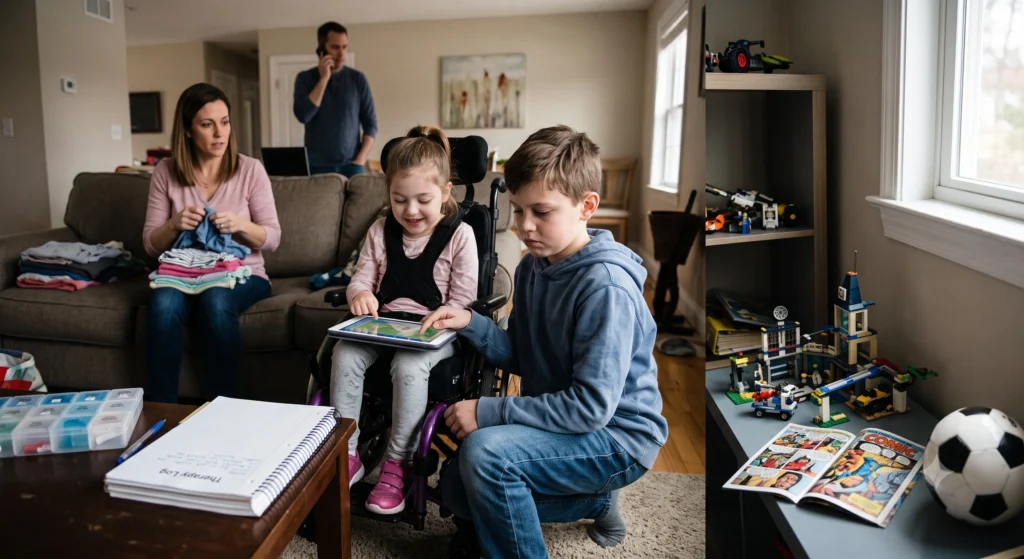
The brutal reality is that you cannot clone yourself. You cannot be in the living room managing a sensory meltdown and in the bedroom helping your daughter practice for her spelling bee at the same time.
To balance the attention in your home, you must bring in outside reinforcements.
At Shal We Home Care, serving Lee, Collier, and Hendry counties, we provide specialized in-home respite care for special needs families.
- Buying You Time: When you hire a trained caregiver for 4 hours on a Saturday, you are not just caring for your autistic child; you are buying the time to take your neurotypical child to the park, just the two of you.
- Removing the “Third Parent” Burden: Our caregivers handle the feeding, the supervision, and the safety protocols, meaning your neurotypical child never has to act as the babysitter.
- Restoring the Sibling Dynamic: When a professional is managing the medical and behavioral needs, the siblings are free to just play together safely, allowing them to actually build a loving relationship.
- Recognize the Silence: “Glass children” often hide their struggles to avoid stressing their parents, leading to severe anxiety and perfectionism.
- Validate the Resentment: Allow your neurotypical child to express anger and frustration about their sibling’s disability without making them feel guilty.
- Avoid Parentification: Never force a sibling into the role of a caregiver; protect their right to have a normal childhood.
- Protect 1-on-1 Time: Schedule dedicated, uninterruptible time with your neurotypical child every week.
- Use Respite Care: Utilize professional home care agencies to manage the special needs care, freeing you up to be a present, focused parent to all your children.

Are you struggling to balance the needs of all your children? You don’t have to spread yourself so thin that everyone suffers.
Contact Shal We Home Care today. Let our specialized respite caregivers step in so you can step back and reconnect with your entire family in Southwest Florida.