
Does your aging parent refuse to use a walker or cane despite frequent falls? Learn the psychology of mobility resistance and actionable scripts to gain compliance.
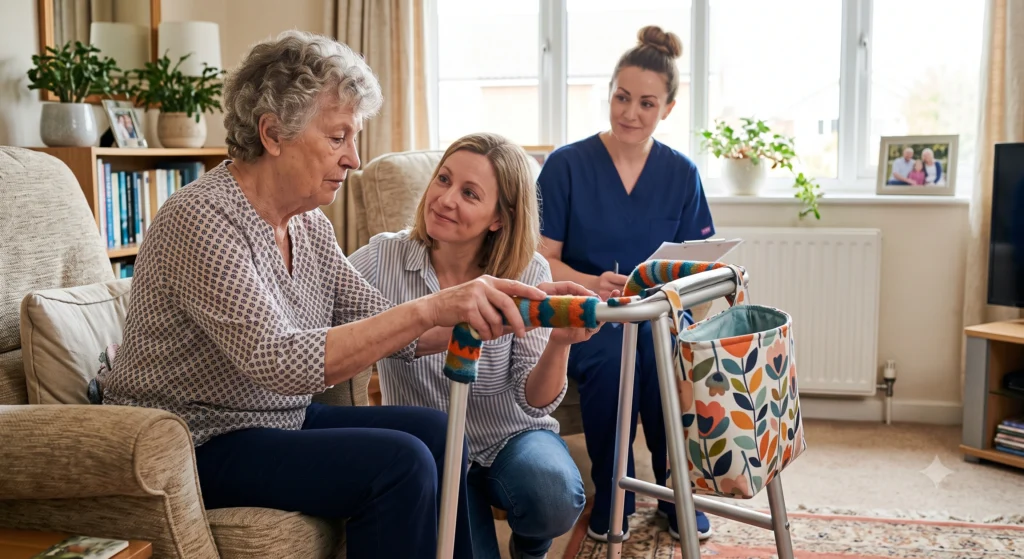
Seniors often refuse to use walkers, canes, or wheelchairs out of a deep psychological fear of appearing “old,” frail, or losing their independence. To convince a stubborn parent to use a mobility aid, adult children should stop nagging and instead frame the device as a tool for freedom and stamina. Highly effective strategies include customizing the walker to remove the “medical” look, enlisting a doctor to medically prescribe its use (taking the blame off the family), and utilizing a professional caregiver to enforce mobility rules when the family isn’t present.
If you spend any time observing your aging parent in their Southwest Florida home, you might notice a terrifying habit. Instead of walking smoothly down the hallway, they hold onto the back of the sofa, then reach for the dining room chair, then grasp the doorframe.
This is known as “furniture surfing.” It is a massive red flag that their balance is failing.
So, you go to the medical supply store, buy them a beautiful, sturdy rollator walker, and bring it to their house. You expect them to be grateful. Instead, they look at it with disgust, push it into the spare bedroom, and say, “Take that away. I don’t need that. I’m not an invalid.”
A few weeks later, they fall and end up in the emergency room at Lee Memorial or NCH with a fractured hip.
Fighting with an aging parent about using a cane or a walker is one of the most frustrating, repetitive arguments an adult child can have. To break through their stubbornness, you have to stop arguing about the physical danger and start addressing the psychological fear.
Why would a rational adult refuse to use a tool that prevents them from falling? Because using a walker represents the ultimate public admission of aging.
- The Loss of Identity: For 80 years, your father was the strong provider. Using a walker forces him to publicly broadcast to his neighbors, his friends, and strangers at Publix that his body is failing. It feels deeply humiliating.
- The Fear of the Nursing Home: Many seniors believe that accepting a walker is the first step on a slippery slope. They think, “If I admit I need a walker today, my kids will force me into a nursing home tomorrow.”
- The “It Makes Me Weaker” Myth: Many seniors falsely believe that using a walker will cause their leg muscles to atrophy faster. (In reality, the opposite is true; a walker allows them to walk further and more often, preserving cardiovascular health).
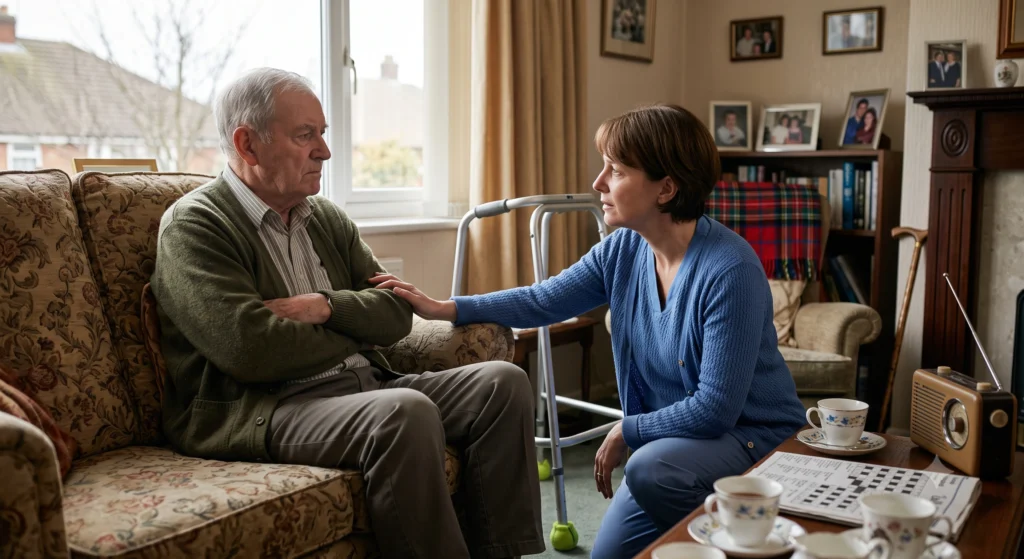
Adult children often get so exhausted by the arguing that they eventually give up. They say, “Fine, Mom, just be careful.”
“Be careful” is not a medical strategy. It relies on the senior having perfect reaction times, which aging strips away. If they trip over a rug, their brain simply cannot send the signal to their foot fast enough to catch themselves. You cannot give up on this issue. You must change your tactics.
Seniors often view their adult children as “kids” who are just being bossy. They will ignore you, but they hold immense respect for medical professionals.
- The Tactic: Before their next checkup, call their primary care doctor or physical therapist privately. Explain that your parent is falling but refusing the walker.
- The Execution: During the appointment, the doctor must look your parent in the eye and say, “I am medically prescribing that you use this rollator at all times. If you do not use it, you will fall, break your hip, and you will not be able to live in your own home anymore.”
- The Result: You are no longer the bad guy. You can simply say, “Dad, I know you hate it, but Doctor Smith ordered it, and we have to follow his instructions.”
You must change the vocabulary you use. Stop focusing on what the walker prevents (falling), and start focusing on what it enables (stamina).
- The Tactic: Do not say, “You need this so you don’t fall.”
- Say this instead: “Mom, I know you get exhausted walking through the botanical gardens. This rollator has a built-in seat. It’s essentially a portable chair. If we use this, you can sit down and rest whenever you want, which means we can stay at the park twice as long!” Framing it as an energy-saving tool removes the stigma of frailty.
Standard walkers are ugly. They look like they belong in a hospital ward, made of sterile gray aluminum and yellow tennis balls.
- The Tactic: Customize it to make it feel like a personal accessory rather than medical equipment. Buy a walker in their favorite color (ruby red or metallic blue). Add a high-quality leather pouch, a cup holder for their coffee, and a specialized cane holder. The sleeker and more personalized the device looks, the more willing they are to be seen with it in public.
If they refuse to use it inside their own house, use their desire to be a good host as leverage.
- The Tactic: If the grandchildren are coming over to visit, tell your parent: “Dad, the kids are going to be running around. For everyone’s safety, the rule today is that we use the walker so no one gets bumped into.”
If your parent continues to dig their heels in, the parent-child dynamic has become too toxic to be productive. Every time you mention the walker, they instantly become angry.
This is where introducing a professional from Shal We Home Care becomes a game-changer for families in Lee, Collier, and Hendry counties.
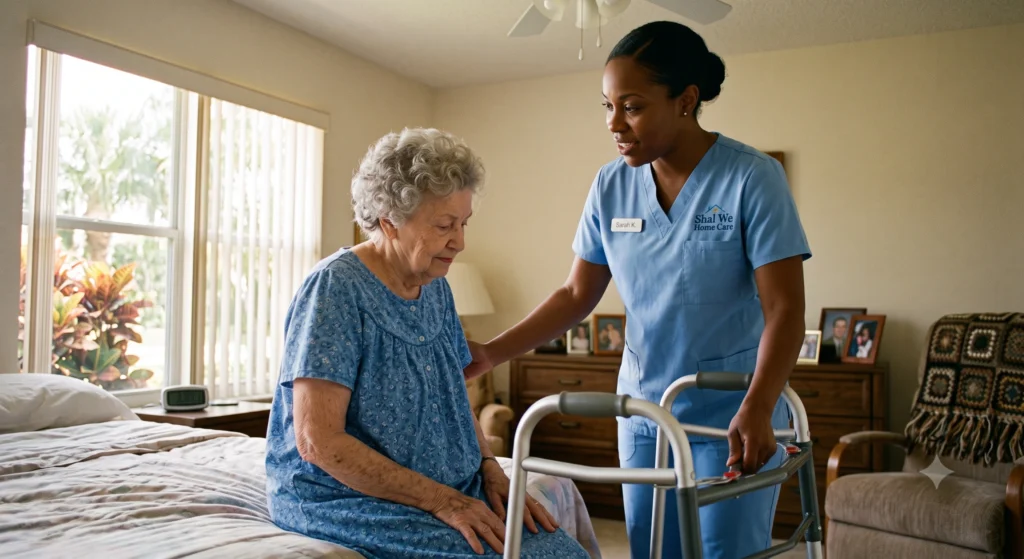
- The Objective Authority: A senior who fiercely fights their daughter will often politely comply with a professional caregiver in scrubs. Our caregivers represent objective, medical authority.
- Consistent Enforcement: We don’t argue; we gently enforce. When it is time to get up, the caregiver smoothly positions the walker in front of the senior, locks the brakes, and provides stand-by assistance. It becomes an undeniable part of the daily routine.
- Preserving Your Relationship: Let us be the ones to enforce the safety rules. You get to step back, stop being the nagging safety monitor, and go back to simply enjoying your parent’s company.
- It’s About Pride: Understand that refusing a walker is driven by a deep psychological fear of looking old and weak.
- Use the Doctor: Offload the argument by having their physician formally “prescribe” the walker and explain the consequences of falling.
- Change the Pitch: Frame the walker as an “energy-saver” with a built-in seat to increase their stamina, rather than a crutch.
- Upgrade the Look: Buy a brightly colored, modern rollator and accessorize it to remove the sterile, “hospital” look.
- Hire an Enforcer: Utilize a professional home caregiver to seamlessly integrate the walker into the daily routine without the emotional family baggage.
Are you exhausted from fighting about fall hazards? You don’t have to carry the burden of being the full-time safety monitor.
Contact Shal We Home Care today. Let our trained professionals ensure your loved one navigates their Florida home safely, preserving their health and your peace of mind.