
Did your elderly parent fall at home? Discover the exact steps to assess for injury, the dangers of lifting them incorrectly, and when to call 911 in Florida.
When a senior falls at home, caregivers must suppress the instinct to immediately lift them, as moving an injured senior can cause lethal internal bleeding or worsen fractures. Instead, caregivers should keep the senior calm on the floor for 5 to 10 minutes, conduct a head-to-toe injury assessment, and check for hidden dangers (especially if the senior takes blood thinners). If uninjured, use the “sturdy chair method” to help them up. If any pain, confusion, or head trauma is present, call 911 immediately. Utilizing professional home care can prevent the next fall from occurring.
If you are a family caregiver, you know the sound. You are in the kitchen preparing lunch, and suddenly, you hear a loud, heavy thud from the bathroom or the bedroom. Your heart stops. You run down the hallway and find your aging parent lying on the floor.
Falls are the leading cause of fatal and non-fatal injuries for older Americans. In Southwest Florida, where tile floors are common to keep homes cool, a slip and fall can have devastating consequences.

In the panicked moments immediately following a fall, family members frequently make critical, well-intentioned mistakes that turn a minor slip into a catastrophic medical emergency. Knowing exactly how to react, how to assess for hidden injuries, and how to lift safely is essential. Here is your step-by-step emergency protocol.
When you see someone you love on the floor, human instinct screams at you to grab them by the arms and yank them up as quickly as possible to “make it okay.”
You must suppress this instinct immediately.
- The Danger of the Yank: If your parent has a hairline hip fracture or a spinal injury, violently pulling them to their feet can sever an artery, cause lethal internal bleeding, or permanently damage the spinal cord. Furthermore, pulling an elderly person by the arms can easily dislocate their fragile shoulders.
- The Action: Take a deep breath. Kneel down next to them. Tell them, “Do not move. Stay right where you are. I am right here with you.”
Before attempting any movement, the senior must remain flat on the floor for 5 to 10 minutes. This allows the initial shock to wear off, preventing them from fainting when they stand up, and allows pain signals to actually reach their brain.
Perform a calm, head-to-toe assessment:
- Check the Head: Look for bleeding, bumps, or asymmetrical pupils. Ask: “Did you hit your head?”
- Check Cognition: Ask them what day it is and where they are. If they are suddenly confused, they may have suffered a concussion or a stroke (which caused the fall).
- Check the Limbs: Ask them to slowly wiggle their toes, then their ankles, then their knees. Repeat with the fingers, wrists, and elbows.
- Check for Asymmetry: Look at their legs. Is one leg suddenly looking shorter than the other, or is one foot unnaturally turned outward? This is a classic sign of a fractured hip.
If your parent is taking anticoagulant medication (blood thinners like Eliquis, Xarelto, Plavix, or Warfarin) for a heart condition, a fall is automatically a high-level medical emergency, even if they claim they feel fine.
- The Risk: Blood thinners prevent clotting. If they hit their head even lightly they can develop a slow, silent subdural hematoma (bleeding in the brain). They might seem perfectly normal for 24 hours before suddenly slipping into a coma.
- The Action: Any senior on blood thinners who falls and hits their head MUST be evaluated at an emergency room or urgent care center immediately via a CT scan.
If and only if they have rested for 10 minutes, have zero pain, and are thinking clearly, you can assist them up. Do not lift them yourself; you will destroy your own back. Let them do the work using the Sturdy Chair Method:
- Bring two sturdy dining room chairs (no wheels, no recliners) and place them near the senior.
- Have the senior roll slowly onto their side, then push up onto their hands and knees (all fours).
- Place one chair directly in front of their head and the second chair behind them.
- Have them place both hands flat on the seat of the front chair.
- Instruct them to bring their strongest leg forward, placing that foot flat on the floor so they are in a kneeling lunge.
- Using their hands on the chair and their strong leg, have them push up while you place a steadying hand on their hips (not their arms).
- Once standing, guide them to sit on the second chair placed behind them.
Do not let embarrassment stop you from calling emergency services. Call 911 immediately if you observe:
- Any loss of consciousness, even for a few seconds.
- Severe pain in the back, neck, or hips.
- The inability to move a limb.
- Bleeding that will not stop with pressure.
- Confusion, slurred speech, or facial drooping.
- If you simply cannot safely get them off the floor without hurting your back. (Paramedics provide “lift assists” frequently; they will gladly help).
A fall changes a senior’s psychology. They develop ptosis (the extreme fear of falling).
To avoid falling again, they stop walking. They stay in their recliner all day. Because they stop moving, their leg muscles atrophy rapidly. Within a few weeks, their legs become so weak that a second, much more severe fall is practically guaranteed. You must encourage them to keep moving, ideally with a walker and physical therapy, to rebuild confidence.
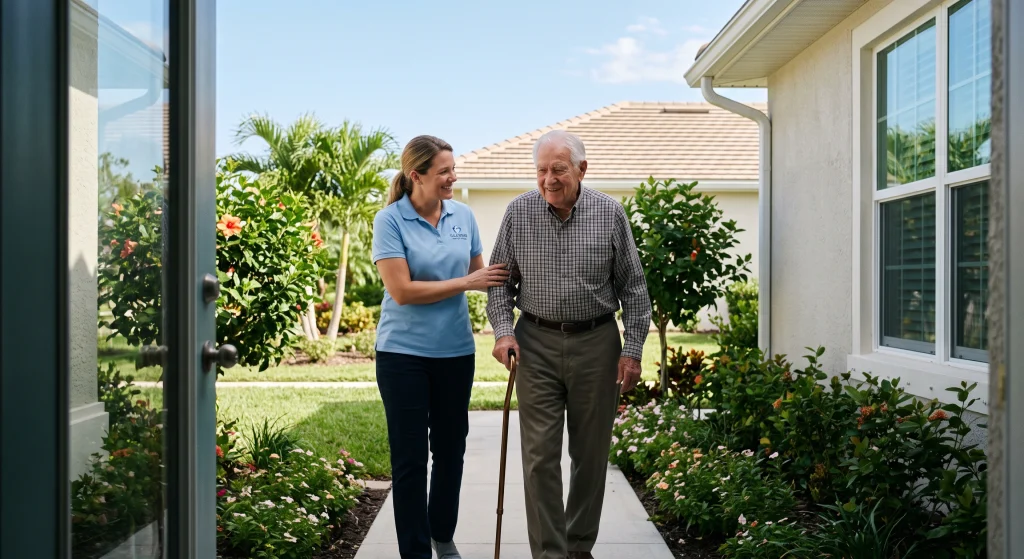
The best way to handle a fall is to prevent it from happening in the first place.
At Shal We Home Care, our priority in Lee, Collier, and Hendry counties is proactive safety.
- Stand-by Assistance: Our caregivers act as a physical buffer during the most dangerous times of day: getting in and out of the shower, getting off the toilet, and transitioning from the bed.
- Environmental Audits: We ensure the home is clear of clutter, throw rugs, and poorly lit hallways that trigger slips.
- Movement Motivation: Our caregivers gently encourage and supervise prescribed physical therapy exercises or daily walks, ensuring your parent maintains the core and leg strength required to stay safely on their feet.
- Do Not Yank: Never pull a fallen senior up by the arms or shoulders; it can cause lethal internal injuries.
- Wait 10 Minutes: Keep them on the floor to let the shock pass and perform a head-to-toe pain assessment.
- Beware Blood Thinners: Any head bump while on anticoagulants requires an immediate ER trip for a CT scan.
- Use the Chair Method: Let the senior do the physical work of getting up by pushing off a sturdy chair while you stabilize their hips.
- Hire Fall Prevention: Utilize professional home caregivers to provide stand-by assistance during high-risk daily activities.
Are you living in fear of the next phone call? Don’t wait for a devastating fall to change your family’s life.
Contact Shal We Home Care today. Let our highly trained caregivers provide the steady hand and watchful eye your loved one needs to remain safely upright in Southwest Florida.