
Overcoming the guilt of moving a parent to memory care is agonizing. Learn how to cope with placement guilt, reframe your role, and ensure they thrive in Florida.
Handling the guilt of placing a parent in a memory care facility requires reframing the decision from a “failure” to a vital medical intervention. Caregivers must acknowledge that providing 24/7 awake dementia care at home is physically impossible for one person. By moving a parent to a specialized facility, adult children can stop acting as exhausted medical managers and return to their primary role as loving family members. Utilizing a private home care agency for supplemental, 1-on-1 companion care inside the facility can further ease the transition.
Almost every adult child has made “The Promise” at some point in their life. Usually, it happens years before illness strikes. Your parent looks at you and says, “Please, whatever happens, promise you will never put me in a home.” And because you love them, you promise.
But Alzheimer’s disease and dementia do not care about promises.
When the disease progresses to the later stages, when wandering at 3:00 AM becomes a nightly occurrence, when aggression flares, or when incontinence care becomes a two-person job, the reality of the situation shatters the promise. You realize that keeping them at home is no longer safe for them, and it is destroying your own physical and mental health.
When families in Southwest Florida finally make the excruciating decision to transition their parent to a memory care facility, they are often crushed by a suffocating wave of guilt. They feel like they have failed. They feel like they have abandoned their parent.
If you are experiencing this, you must read the following words carefully: You have not failed. You are making the hardest, most loving choice possible to ensure their survival.

To begin processing your guilt, you must first acknowledge the mathematical and physical reality of late-stage dementia care.
Memory care is a 168-hour-a-week job. There are 168 hours in a week. One human being cannot stay awake, alert, and physically capable for 168 hours. Even if you have siblings helping, or you hire part-time home care, managing advanced dementia eventually requires a fully staffed, rotating team of awake professionals.
If your loved one’s needs have exceeded what you can safely provide in a residential living room, moving them to an environment built specifically for cognitive decline is not an act of abandonment; it is an escalation of care.

Guilt thrives in the gap between what we wish we could do and what we actually can do. You must reframe how you view this transition.
- It is a Medical Necessity: If your parent needed open-heart surgery, you wouldn’t feel guilty that you couldn’t perform the operation on your kitchen table. You would take them to a hospital. Advanced dementia requires environmental and architectural interventions (locked doors, specialized lighting, 24/7 awake nursing staff) that a standard home simply cannot provide.
- Safety Over Scenery: Your ultimate responsibility as a caregiver is to keep them safe. If staying at home means they might wander into a Florida canal or fall down the stairs while you are sleeping, then “home” is no longer safe. Memory care facilities prioritize safety above all else.

The guilt usually peaks during the first 30 days after move-in. This is known as the “Adjustment Period” or “Transfer Trauma.”
Your parent will likely be confused, angry, and begging to go home. They may cry when you leave. Hearing this will tear your heart out, and your immediate instinct will be to pack their bags and bring them back to your house.
You must hold the line. It takes an average of 4 to 6 weeks for a senior with dementia to acclimate to a new environment and routine. During this time, they are mourning the loss of their old life, and you are mourning it, too. Trust the facility staff. Keep your visits short and positive. When they ask to go home, use validation therapy: “I know you miss your house, Mom. You have a beautiful house. Let’s go look at the garden here.”
One of the most beautiful outcomes of memory care placement is the restoration of your relationship.
When you were the sole caregiver, every interaction was fraught with stress. You were forcing them to shower, fighting with them to take pills, and redirecting their agitation. You were an exhausted case manager.
Once they are settled in a facility, the facility staff takes over the “bad guy” tasks. They handle the bathing, the medication, and the toileting.
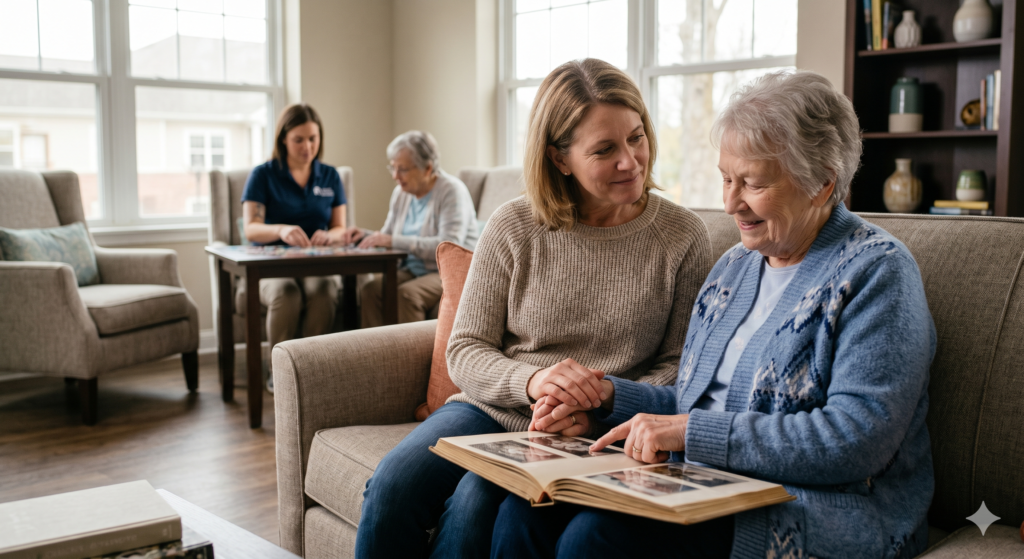
Now, when you walk through the doors of the facility, what is your job? Your only job is to be their daughter or son. You get to bring them a milkshake. You get to hold their hand and listen to music. You get to love them without the crushing weight of physical exhaustion.
Even in the best memory care facilities in Lee or Collier County, staff ratios mean your parent will not get continuous, 1-on-1 attention every second of the day.

For families who feel guilty about their parent feeling “lonely” in a facility, Shal We Home Care offers a powerful solution: supplemental facility care.
- We Go Where They Are: Our caregivers frequently go into assisted living and memory care facilities to provide dedicated 1-on-1 companion care.
- The Transition Bridge: During that difficult first month of adjustment, a Shal we caregiver can sit with your parent for a few hours a day. We provide a familiar, dedicated friend to read to them, advocate for them, and ease their anxiety when the facility staff is busy with other residents.
- Your Peace of Mind: Knowing that a dedicated professional is visiting your parent to give them undivided attention completely eliminates the lingering guilt of placement.
- Forgive Yourself: Breaking “The Promise” to keep them at home is often a medical necessity, not a moral failure.
- It’s About Safety: 24/7 dementia care is impossible for one person to provide; moving them to a facility is an act of protection.
- Expect a Rough Month: The first 30 days will involve tears and anger. Stay strong and trust the adjustment process.
- Get Your Relationship Back: Placement allows you to stop being an exhausted nurse and return to being a loving child.
- Use Supplemental Care: Hire a private companion from a home care agency to provide dedicated 1-on-1 attention inside the facility for ultimate peace of mind.

Are you struggling with the transition to memory care? You can still provide incredible support even if they no longer live with you.
Contact Shal We Home Care today to learn how our caregivers provide supplemental 1-on-1 companionship inside Southwest Florida memory care facilities.