
Caring for a parent with Parkinson’s in Florida? Learn expert strategies to manage “freezing of gait,” medication timing, and safe home mobility.
Managing Parkinson’s disease at home requires adapting to the senior’s fluctuating mobility. To overcome “Freezing of Gait” (FOG), where the feet feel glued to the floor, caregivers should use visual cues like laser pointers or auditory cues like rhythmic counting to trick the brain into stepping forward. Additionally, families must meticulously time medications (levodopa) to maximize “on” periods, remove visual clutter that triggers freezing, and utilize specialized in-home caregivers to safely assist with transfers during rigid “off” periods.
Parkinson’s disease is one of the most complex conditions a family can manage at home. Unlike other conditions where a senior’s physical decline is steady and predictable, Parkinson’s is defined by its dramatic, hour-to-hour fluctuations.
A senior with Parkinson’s might be able to walk unassisted to the kitchen at 9:00 AM, but by 11:00 AM, their muscles may become so rigid they cannot rise from their chair. They deal with resting tremors, rigid muscles, slowness of movement (bradykinesia), and severe balance issues.
For family caregivers in Southwest Florida, keeping a loved one safe requires moving beyond standard fall-prevention advice. You must learn how to navigate the neurological quirks of the disease. Here is a comprehensive guide to managing Parkinson’s mobility challenges at home.
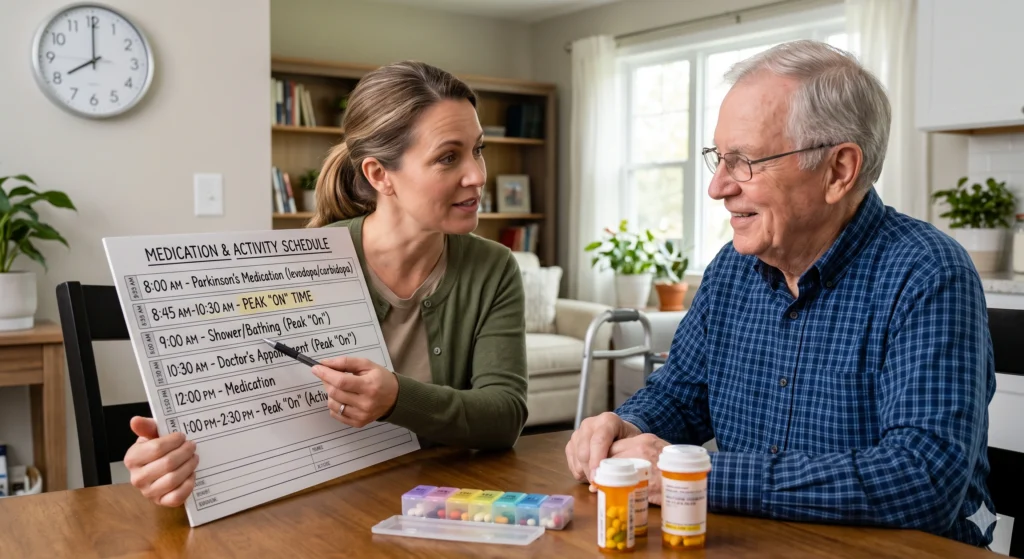
The core treatment for Parkinson’s disease is medication (typically levodopa/carbidopa) that replaces the missing dopamine in the brain. However, as the disease progresses, the “window of effectiveness” for these medications shrinks.
This creates the “On/Off” phenomenon:
- “On” Periods: The medication is working. The senior can move fluidly, their tremors subside, and they feel energetic.
- “Off” Periods: The medication wears off before the next dose is due. The senior suddenly becomes “frozen,” stiff, and highly prone to falling.
Caregiver Strategy: You must meticulously schedule your loved one’s day around their medication. If they have a doctor’s appointment or want to take a shower, it must be scheduled during their peak “On” time (usually 30 to 60 minutes after taking their medication). Bathing a senior during an “Off” period is dangerous for both the senior and the caregiver.
One of the most terrifying and frustrating symptoms of advanced Parkinson’s is Freezing of Gait (FOG).
During an episode of FOG, the senior’s brain sends the signal to walk, but the legs refuse to obey. The senior will describe it as feeling like their feet are “superglued to the floor.” Because their upper body continues to move forward while their feet remain stuck, FOG is the leading cause of face-forward falls in Parkinson’s patients.
Freezing typically happens during specific triggers:
- Initiating walking (taking the first step).
- Turning around or pivoting.
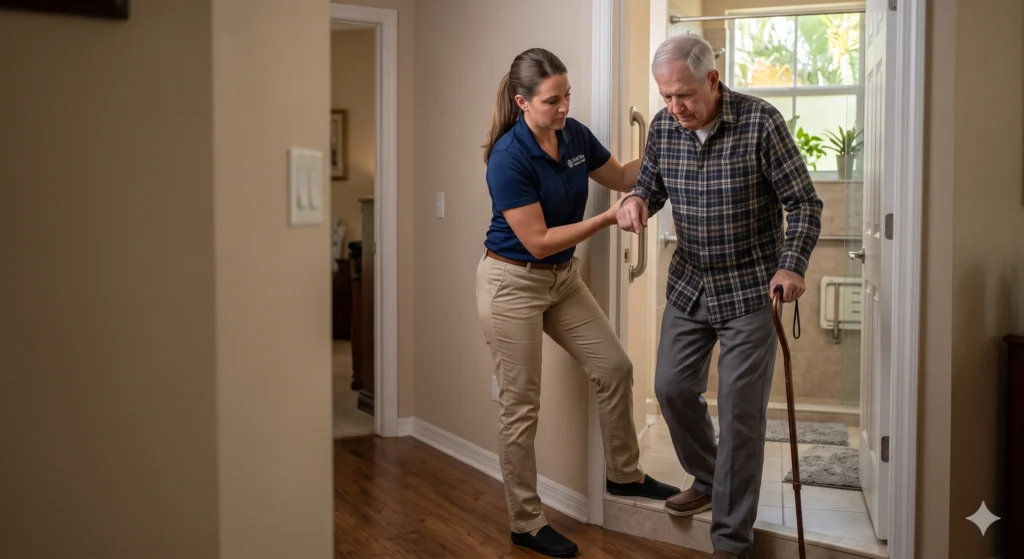
- Walking through narrow spaces (like doorways).
- Transitioning from one floor type to another (e.g., moving from carpet to tile).
When a senior is frozen, do not push or pull them. This will instantly cause a fall. Instead, you must use “sensory cueing” to bypass the damaged part of the brain and activate a different neural pathway to initiate movement.
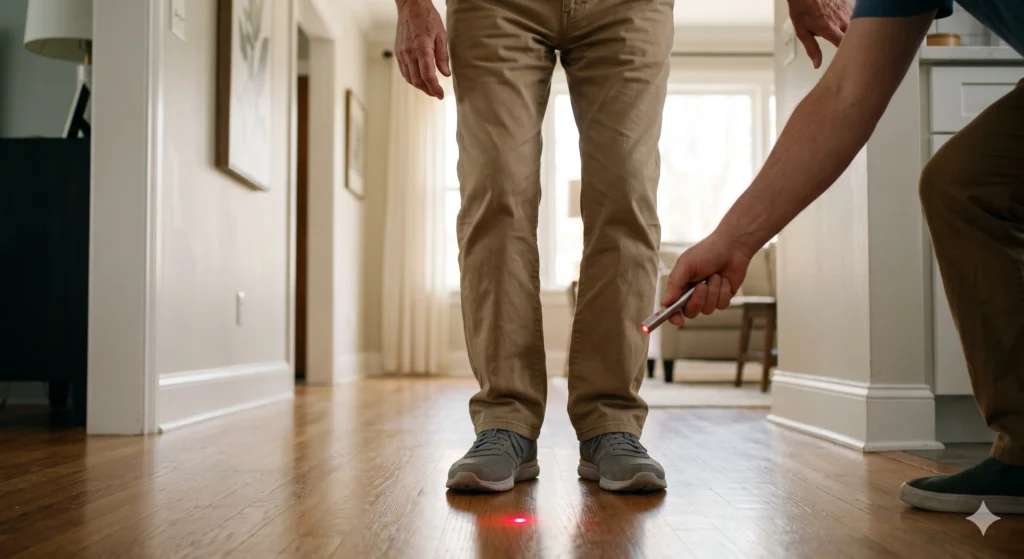
- Visual Cues (Stepping Over): Place a physical target on the floor for them to step over. You can drop a bright piece of paper, place your own foot horizontally in front of theirs, or use a specialized cane that projects a red laser line onto the floor. Tell them, “Step over the line.” The brain focuses on the visual obstacle, breaking the freeze.
- Auditory Cues (Marching): Provide a steady, rhythmic beat. Count out loud (“One, Two, One, Two”) or sing a marching song. Tell the senior to march to the beat.
- The “Weight Shift” Trick: When they are stuck, ask them to simply sway their weight gently from side to side (left foot, right foot). Shifting the center of gravity often unlocks the frozen muscles, allowing them to take a step.
Standard home safety modifications apply, but Parkinson’s requires a few specialized adjustments:
- Eliminate Floor Patterns: Busy patterns on rugs or tiles act as visual clutter that can trigger freezing of gait. The brain cannot process the complex visual input. Use solid-colored mats, and ensure all flooring transitions (like saddle thresholds in doorways) are as flat and flush as possible.
- Weighted Utensils: Severe hand tremors make eating incredibly frustrating. Weighted utensils dampen the tremor, allowing the senior to feed themselves with dignity. Use plates with high “lip” edges so they can scoop food without pushing it off the plate.
- Firm, High Seating: Seniors with Parkinson’s struggle to initiate the standing motion. Deep, plush sofas are impossible to get out of. Ensure they have a firm chair with sturdy armrests and a slightly elevated seat cushion.
As the muscles become rigid, the muscles in the throat are also affected. Many advanced Parkinson’s patients develop dysphagia (difficulty swallowing).
- The Risk: Food or liquids can easily slip into the lungs, causing aspiration pneumonia.
- The Solution: They may require their liquids to be thickened (using products like Thick-It), or their food may need to be pureed or minced. Always ensure they are sitting bolt-upright at a 90-degree angle while eating, and never rush them.
Caring for someone with Parkinson’s is physically demanding. Lifting, transferring, and catching a freezing senior takes a massive toll on a family caregiver’s back and energy levels.
At Shal We Home Care, serving Lee, Collier, and Hendry counties, we provide specialized support for neurodegenerative diseases:
- Medication Adherence: We ensure those vital levodopa doses are taken at the exact right minute to prevent dangerous “off” periods.
- Safe Transfers: Our caregivers are trained in body mechanics and stand-by assistance, ensuring your loved one navigates doorways and bathrooms safely without falling.
- Respite for the Family: We take over the heavy physical lifting, allowing family members to rest, recover, and avoid severe caregiver burnout.
- Timing is everything: Schedule all major activities (bathing, outings) during the senior’s peak “on” medication periods.
- Don’t Pull a Frozen Senior: If they experience freezing of gait, do not push them. Use laser pointers, counting, or weight-shifting to unlock their feet.
- Clear the Floor: Remove patterned rugs and complex visual clutter that triggers freezing in doorways.
- Watch for Swallowing Issues: Monitor them for coughing during meals, which is a sign of dangerous dysphagia.
- Get Physical Backup: Utilize trained home caregivers to manage the heavy physical transfers and ensure medication is taken precisely on time.
Are you overwhelmed by the unpredictable nature of Parkinson’s? You don’t have to manage these complex mobility challenges alone.
Contact Shal We Home Care today for a specialized assessment. Our trained caregivers can keep your loved one safe and moving in Southwest Florida.