
Florida seniors lose billions to financial scams. Discover why isolation and mild dementia make them targets, and learn actionable steps to protect your parent’s wealth.
Seniors are highly vulnerable to financial scams due to isolation, loneliness, and early-stage cognitive decline, which impairs their executive function and natural skepticism. The most common threats include the “Grandparent Scam,” tech support fraud, and Medicare phishing. Caregivers can protect their aging parents by freezing their credit, setting up automated bank transaction alerts, utilizing monitored prepaid cards for daily spending, and using companion caregivers to reduce the profound loneliness that scammers prey upon over the phone.
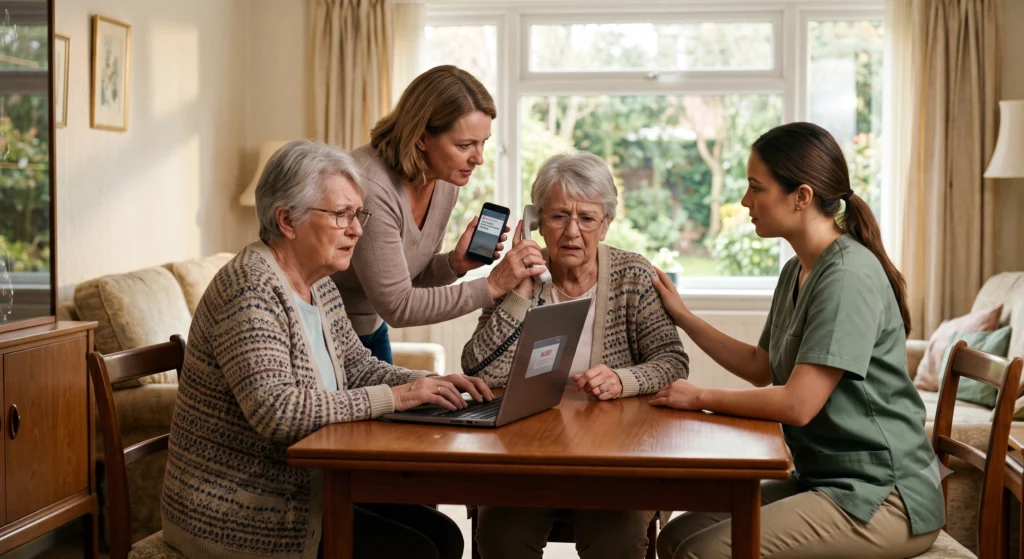
Southwest Florida is a paradise for retirees, making it one of the wealthiest demographic regions in the country. Unfortunately, where there is accumulated wealth, there are predators.
Financial exploitation and fraud targeting older adults is a booming, billion-dollar illicit industry. Every single day, sophisticated scam rings target seniors in Fort Myers, Naples, and Cape Coral, utilizing everything from frightening phone calls to romantic online manipulation. The results are often devastating, with seniors losing their entire life savings, money they rely on to pay for their medical and home care needs, in a matter of days.
Adult children are often baffled when they discover their intelligent, previously sharp parent has wired $20,000 to a stranger. They ask, “How could they be so gullible?”
To protect your aging parent, you must understand that falling for a scam is rarely about gullibility; it is the direct result of biological brain changes and social isolation.
Scammers do not target intelligence; they target vulnerabilities. There are two massive factors that make seniors the perfect victims:
1. The Decline of Executive Function As the brain ages, or as early-stage dementia (mild cognitive impairment) begins, the brain’s frontal lobe degrades. The frontal lobe is responsible for executive function, logic, and skepticism. A healthy brain hears a panicked voice on the phone and pauses to verify the facts. An aging brain, stripped of its protective filter, processes the panic immediately and moves straight into compliance. They literally lose the neurological ability to detect deception.
2. The Epidemic of Loneliness Scammers are master manipulators of emotion. For a senior living alone who hasn’t spoken to anyone all week, a phone call from a friendly, chatty “customer service rep” or a “new online friend” feels like a lifeline. Scammers exploit this profound loneliness, building fake rapport and trust before asking for money.
You must educate your parents about the specific scripts scammers use.
- The “Grandparent” Scam: A frantic call in the middle of the night. A voice says, “Grandma, it’s me. I was in a car accident/arrested in Mexico, and my nose is broken, so I sound different. I need you to wire $5,000 for bail right now, but please don’t tell Mom and Dad; they’ll be so mad.” The panic overrides the senior’s logic, and they send the money.
- Tech Support/Virus Scams: A terrifying pop-up takes over the senior’s computer screen with a loud alarm, claiming the computer is locked by the FBI or a virus. They are instructed to call a number, where a scammer convinces them to buy thousands of dollars in Apple or Target gift cards to “unlock” the computer.
- Medicare/Social Security Phishing: A caller claims to be from the government, stating the senior’s Medicare card has been compromised and they need to verify their Social Security number and bank routing information to issue a new one.
- The Romance Scam: Often initiated on Facebook or Words With Friends, a scammer builds a long-distance romantic relationship with a lonely widow or widower over months, eventually asking for money to pay for a “medical emergency” or a “plane ticket to finally visit.”
Financial fraud often happens in secret because the senior is too embarrassed to admit they made a mistake. Watch for these behavioral and financial red flags:
- You notice stacks of sweepstakes mailings or unusual, cheap magazines arriving at the house (indicating they are on a “sucker list”).
- They are suddenly secretive when they are on the phone or quickly close their laptop when you enter the room.
- You see unexplained withdrawals, wire transfers, or large checks written to “Cash” on their bank statements.
- They mention a “new friend” they met online who lives overseas.
You must put physical and digital barriers between your parent’s wealth and the outside world.
- Freeze Their Credit: Contact all three major credit bureaus (Equifax, Experian, and TransUnion) and place a security freeze on their credit profile. This prevents scammers from opening new credit cards or loans in their name, even if they have their Social Security number.
- Set Up Bank Alerts: If you are a joint owner or power of attorney on their checking account, set up automated text alerts. Have the bank text you immediately if any transaction over $200 occurs, allowing you to stop fraudulent wires before they clear.
- Register on the Do Not Call List: Register their landline and cell phone on the National Do Not Call Registry to reduce the volume of predatory telemarketers.
- The “Hang Up and Verify” Rule: Teach your parent a non-negotiable rule: The IRS, Medicare, and the police will never call you asking for payment over the phone or in gift cards. If someone calls demanding money, teach them to hang up immediately and call you.
If your parent’s cognitive decline makes managing a traditional debit card too dangerous, but you still want them to have the dignity of spending their own money, transition them to a monitored prepaid card (like TrueLink Financial).
These specialized cards allow you, the adult child, to act as the administrator. You load a set amount of money (e.g., $500 a month) onto the card for their groceries and hair appointments. You can explicitly block the card from being used for wire transfers, international purchases, or charitable donations, effectively walling off their life savings from predators.
The most effective weapon against a scammer is not software; it is the presence of a trusted human being.
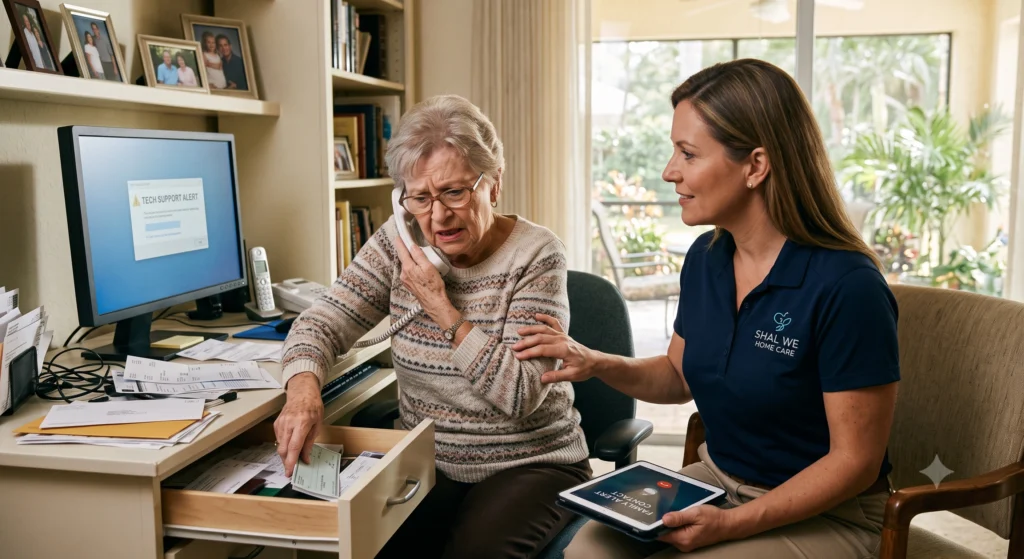
At Shal We Home Care, serving Lee, Collier, and Hendry counties, our companion caregivers provide a crucial layer of defense against exploitation.
- Curing the Loneliness: We provide the genuine, warm social interaction that seniors crave, drastically reducing their susceptibility to “friendly” scammers on the phone or online.
- The Sighted Guide: Our caregivers are an extra set of eyes and ears. If a caregiver notices the senior frantically searching for their checkbook while on the phone with a “tech support agent,” the caregiver can intervene, de-escalate the panic, and alert the family immediately.
- Mail Sorting: We can help sort the daily mail, quietly separating legitimate bills from predatory sweepstakes and junk mail before it ever reaches the senior’s hands.
- It’s Biology, Not Gullibility: Cognitive decline destroys the brain’s ability to be skeptical, making seniors highly vulnerable to high-pressure scams.
- Beware the Panic: Educate your parents about the “Grandparent Scam” and the “Tech Support” pop-ups that rely on creating sudden panic.
- Freeze the Credit: Lock down their credit files across all three bureaus to prevent identity theft.
- Use Tech Safely: Set up automated text alerts on their bank accounts and transition them to monitored prepaid cards to limit exposure.
- Cure the Isolation: Utilize professional companion caregivers to provide the social connection that keeps scammers at bay.
Are you worried about your parent’s vulnerability to scams? Don’t let predators drain their hard-earned savings.
Contact Shal We Home Care today. Let our trusted caregivers provide the safe companionship and watchful eye your loved one needs in Southwest Florida.