
What happens when an autistic teen ages out of the Florida school system at 22? Learn how to navigate the “Services Cliff,” Vocational Rehab, and adult day programs.
When autistic teens in Florida age out of the public school system at age 22, they face the “Services Cliff,” a sudden end to federally mandated therapies and structured daily routines. To survive this transition, parents must proactively establish legal guardianship or supported decision-making before age 18, apply for Florida Vocational Rehabilitation (VR) for job coaching, secure placement in Adult Day Training (ADT) programs, and utilize private respite companion care to maintain routine and prevent severe behavioral regressions.
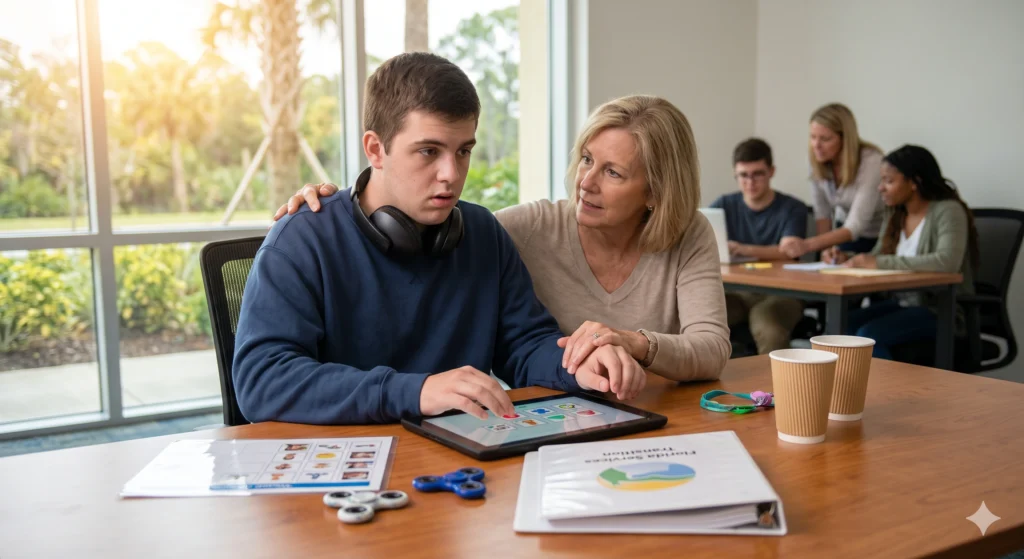
For parents of neurotypical children, a high school or college graduation is a time of immense celebration and freedom.
For parents of teens with severe Autism Spectrum Disorder (ASD), Down syndrome, or intellectual disabilities, graduation is a source of profound dread. In the state of Florida, the public school system is federally mandated by the IDEA (Individuals with Disabilities Education Act) to provide education, speech therapy, occupational therapy, and daytime structure until the individual turns 22 years old.
The day your child turns 22 (or accepts a standard diploma earlier), that safety net instantly vanishes. The school bus stops coming. The therapies end. The structured 8-hour day disappears.
This terrifying phenomenon is universally known in the special needs community as The Services Cliff. Families in Southwest Florida are suddenly left scrambling, wondering, “What is my adult child going to do all day while I am at work?” If you do not prepare for the cliff years in advance, your family will be in crisis. Here is a roadmap to surviving the transition.
The cliff represents the shift from an entitlement system to an eligibility system.
Under age 22, your child was entitled to services by law. After age 22, your adult child must prove they are eligible for services through state agencies like the Agency for Persons with Disabilities (APD). As we discussed in our guide on the APD Waitlist, proving eligibility does not guarantee funding; it often just guarantees a spot on a 7-to-10-year waitlist.
Therefore, you must build your own parachute before your child reaches the edge of the cliff.
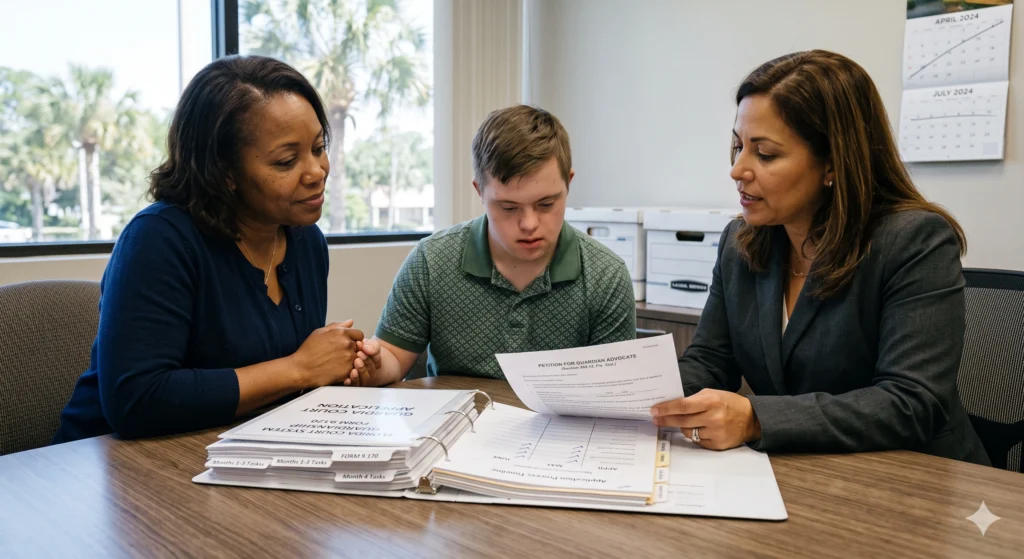
The transition actually begins at age 18, not 22. In the eyes of Florida law, when your neurodivergent child turns 18, they are legally an adult. Without legal intervention, doctors will not speak to you, and you cannot make medical or financial decisions for them.
- Guardianship: If your child has severe cognitive impairments and cannot safely manage their own life, you must apply for legal guardianship (or guardian advocate status) through the Florida court system. This process takes months and requires a lawyer, so begin when your child is 17.
- Supported Decision-Making: If your child is higher-functioning and does not require full guardianship, you can establish legal “Supported Decision-Making” agreements and Durable Powers of Attorney, allowing them to retain their rights while legally authorizing you to assist them.
If your young adult is capable of working in the community, you must engage with Florida Vocational Rehabilitation (VR).
VR is a federal-state program that helps individuals with physical and mental disabilities find and maintain employment.
- Transition Services: By law, your child’s high school must invite VR counselors to their IEP (Individualized Education Program) meetings during their final years of high school.
- Job Coaching: VR can provide funding for a “job coach,” a professional who goes to a workplace (like Publix or a local warehouse) with your young adult to help them learn the tasks and interact appropriately with co-workers.
If your young adult requires constant supervision and cannot participate in competitive employment, they will likely need an Adult Day Training (ADT) program.
ADTs (sometimes called day programs or workshops) are localized centers where adults with developmental disabilities go during the day to learn life skills, socialize, and participate in community outings.
- The Catch: Good ADT programs in Lee and Collier counties have long waiting lists. You must tour facilities and apply years before your child ages out of school.
- Funding: If you do not have the APD iBudget waiver to pay for the ADT, you will have to pay out-of-pocket (private pay) to secure their spot.
When the school routine abruptly ends, the autistic brain experiences severe distress. Without a reason to wake up early, young adults often reverse their sleep schedules, staying awake all night. Without daily social interaction, they retreat into isolation and intense special interests (like watching the same YouTube video for 12 hours straight).
This lack of structure frequently leads to a massive behavioral regression. Meltdowns increase, aggressive behaviors resurface, and previously mastered life skills (like hygiene) deteriorate.
Building a fully structured adult life takes time. Often, there are gaps; maybe the ADT program is only 3 days a week, or maybe they only work 10 hours a week with their VR job coach.
At Shal We Home Care, we provide specialized companion care and respite services to bridge the services cliff.
- Maintaining the Routine: Our caregivers come to the home on the “off days” to maintain a strict routine. We get them out of bed, ensure they shower, and engage them in productive activities to prevent behavioral regression.
- Community Integration: We don’t just sit in the house. Our caregivers take young adults out into the Southwest Florida community, to the library, the park, or volunteering, teaching them the practical life skills needed to thrive in adulthood.
- Parental Relief: We provide the supervision needed so that you, the parent, can continue working your full-time job without terror.
- Start at 17: Begin the legal process for guardianship or supported decision-making before their 18th birthday.
- Utilize VR: Engage Florida Vocational Rehabilitation while they are still in high school to secure job coaching services.
- Tour ADTs Early: Get on the waitlists for local adult day training programs years before they actually graduate.
- Beware Regression: The sudden loss of school structure causes severe behavioral regression; a new daily routine must be enforced immediately.
- Bridge the Gap: Hire professional companion caregivers to fill the empty days of the week, ensuring your young adult remains active, supervised, and engaged.

Is the “Services Cliff” rapidly approaching for your family? You don’t have to face the free-fall alone.
Contact Shal We Home Care today. Let our specialized caregivers help you build a structured, joyful, and safe adult life for your neurodivergent young adult in Southwest Florida.