
When an autistic teen or adult experiences a violent meltdown, safety is the only priority. Learn advanced de-escalation, safe positioning, and post-crisis strategies.
Managing violent or aggressive meltdowns in neurodivergent individuals requires prioritizing physical safety over behavioral correction. Caregivers must immediately clear the room of hazardous objects and other children, adopt a non-threatening, bladed body posture, minimize all verbal communication to reduce sensory input, and never attempt to physically restrain the individual unless there is an imminent threat to life. Utilizing professional, crisis-trained respite caregivers can provide families with the necessary support to maintain a safe home environment.
There is a side to autism and neurodivergent parenting that is rarely discussed in public due to immense stigma, shame, and fear. It is the reality of severe, aggressive meltdowns.
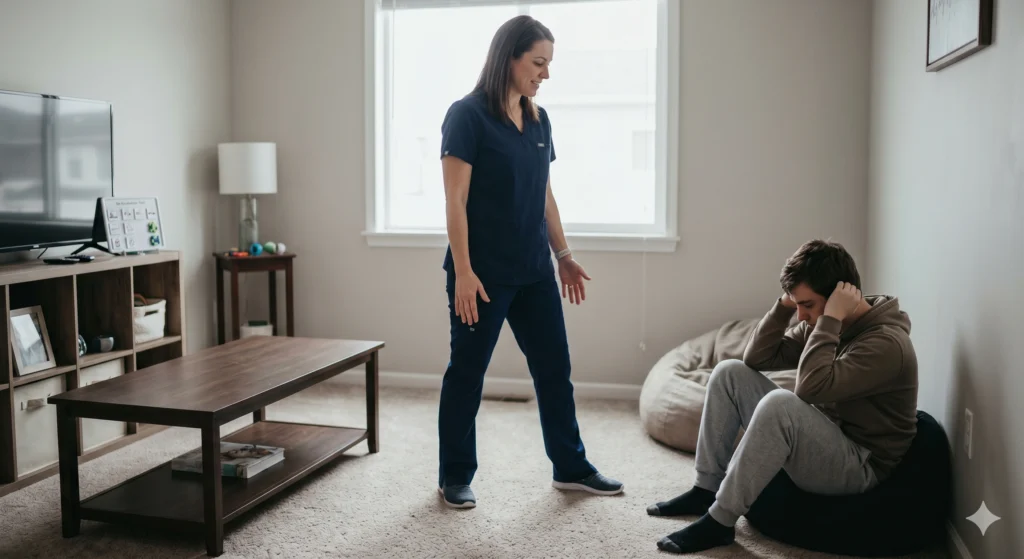
When a neurodivergent child is 6 years old, a physical meltdown, kicking, hitting, or throwing items is manageable. A parent can usually safely scoop the child up and move them to a quiet room. However, when that individual grows into a 16-year-old or a 25-year-old with an adult body and adult strength, those same meltdowns become physically dangerous for the individual, their siblings, and their parents.
Families in Southwest Florida dealing with severe behavioral challenges often feel incredibly isolated. They stop inviting people over, they hide the bruises, and they live in a state of hyper-vigilance, walking on eggshells to avoid triggering an episode.
If you are experiencing this, you must know two things: You are not alone, and it is not bad behavior. It is a neurological crisis. Managing it requires shifting from a “parenting” mindset to a clinical “crisis management” mindset.
To de-escalate violence, you must understand where it comes from.
An aggressive meltdown is not a temper tantrum. A tantrum is a goal-directed behavior (e.g., “I will scream until you give me the iPad”). If you give them the iPad, the tantrum stops.
A meltdown is a total autonomic nervous system override. The individual has experienced a sensory or emotional overload so severe that their amygdala (the brain’s threat center) has completely hijacked their frontal lobe (the logic center). They are in a pure “fight or flight” state. Their body is flooded with adrenaline. They are not trying to hurt you maliciously; their brain literally perceives that they are fighting for their life against an invisible threat.
You cannot reason with someone in a fight-or-flight state. Logic is offline.
When a violent meltdown begins, your only goal is the physical safety of everyone in the room. You are not trying to teach a lesson.
- Evacuate the Innocent: Immediately instruct all other children, vulnerable adults, or pets to leave the room.
- Clear the Hazards: Do not try to move the dysregulated individual. Instead, move the environment. Quietly and swiftly remove anything that could be thrown or used as a weapon (lamps, heavy remotes, glass objects, and sharp corners).
- Create a Buffer: Put a soft barrier, like a large couch cushion or a beanbag chair, between you and the individual if they are lashing out. If they punch or kick the cushion, they will not hurt their hands, and you will remain safe.
Because the auditory processing centers of their brain are offline, the words you say do not matter nearly as much as how you look. Your body language must project absolute calm and non-threat.
- The “Bladed” Stance: Never stand square, facing the individual directly with your chest puffed out. This is biologically interpreted as a challenge. Turn your body sideways at a 45-degree angle (a “bladed” stance), keep your knees slightly bent, and keep your hands visible and open at waist height.
- Lower Your Altitude: Standing over someone who is seated or on the floor is intimidating. Slowly lower your center of gravity. Sit on a chair or kneel at a safe distance so you are below their eye level.
- Avert Direct Eye Contact: Prolonged, direct eye contact during a crisis is perceived by the amygdala as aggressive stalking behavior. Look at their hands or their shoulders, offering only brief, soft glances at their face.

In the heat of the moment, human instinct often causes caregivers to do the exact opposite of what is helpful.
- DO NOT YELL OR COMMAND: Shouting “Stop it right now!” only adds massive auditory sensory input to an already overloaded brain. It is like pouring gasoline on a fire. If you must speak, use a whisper.
- DO NOT BLOCK EXITS: Never stand between the dysregulated individual and the door. If their “Fight or Flight” system chooses “Flight,” and you are in the way, they will fight through you to escape. Leave the path to a safe room wide open.
- DO NOT RESTRAIN: Unless the individual is in immediate, lethal danger (e.g., running into a busy highway or actively self-harming with a weapon), do not attempt a physical restraint. Restraining an adult requires highly specialized, multi-person training. Amateur restraints almost always result in severe injury to the caregiver or the autistic individual.
A violent meltdown burns an astronomical amount of physical and emotional energy. When the adrenaline finally crashes, the individual will enter a “recovery phase” (often referred to as a meltdown hangover).
- The Crash: They may become profoundly exhausted, fall asleep on the floor, or begin crying as they realize what happened. Shame and confusion are very common.
- Do Not Lecture: This is not the time to say, “Look what you broke.” Their brain is still incredibly fragile. Offer a glass of cold water, a weighted blanket, and low lighting.
- Reassurance: Keep it simple: “You are safe. I am here. We are okay.”
Living in a constant state of hyper-vigilance causes severe caregiver PTSD and burnout. You cannot manage this level of intensity 365 days a year without relief.
At Shal We Home Care, serving families in Lee, Collier, and Hendry counties, we provide highly specialized caregivers trained in neurodivergent behavioral management.
- The Objective Buffer: When an individual directs aggression at a parent, the emotional history amplifies the event. A trained professional caregiver acts as an objective, emotionally detached buffer who can de-escalate situations utilizing clinical best practices.
- Preventing Burnout: By allowing our team to step in for respite care, parents can step out of the “crisis manager” role, leave the house without fear, and restore their own frayed nervous systems.
- It’s Biology, Not Behavior: Violent meltdowns are a neurological “fight or flight” response, not a calculated attempt to be bad.
- Clear the Room: Move objects and other people out of the way rather than trying to physically move the dysregulated individual.
- Watch Your Body Language: Use a sideways stance, lower yourself to their eye level, and avoid direct, aggressive eye contact.
- Silence is Golden: Stop talking. Extra words equal extra sensory overload.
- Seek Professional Backup: Utilize trained respite caregivers to manage behavioral volatility and protect your family’s mental health.

Are you living in fear of the next meltdown? You do not have to carry this heavy burden alone.
Contact Shal We Home Care today for a confidential assessment, and let our trained professionals provide the safe, structured respite your family desperately needs in Southwest Florida.