
Puberty brings complex hygiene and privacy challenges for teens with autism and developmental disabilities. Learn how to teach boundaries, body autonomy, and self-care.
Navigating puberty with a special needs teen requires teaching hygiene and privacy through concrete, literal rules and visual schedules. Parents must explicitly define “public” versus “private” behaviors and body parts, use step-by-step visual charts for complex new hygiene tasks (like applying deodorant or managing menstruation), and enforce bodily autonomy to protect the teen from abuse. Utilizing a professional caregiver can also help maintain boundaries and reduce parent-child friction during these sensitive transitions.
Raising a neurodivergent child involves celebrating unique milestones on your own timeline. However, there is one milestone that adheres strictly to a biological clock, regardless of a child’s developmental age: puberty.
For parents of teens with Autism Spectrum Disorder (ASD), Down syndrome, or intellectual disabilities, the onset of puberty is often a time of intense anxiety. Your child may still enjoy watching cartoons aimed at toddlers, but their body is rapidly developing into an adult.
This collision of childhood innocence and adult biology creates a minefield of challenges. Hormones cause sudden mood swings and behavioral regressions. New, complex hygiene tasks are suddenly required. Most pressingly, the child begins experiencing new physical urges without the social filter or executive function to understand where and when it is appropriate to act on them.

In Southwest Florida, many families struggle to find resources to help navigate this delicate phase. Here is a compassionate, practical guide to teaching hygiene, enforcing privacy, and protecting your special needs teen during puberty.
Neurodivergent individuals, particularly those on the autism spectrum, tend to be very literal thinkers. They do not naturally pick up on subtle social cues or unwritten societal rules. If an autistic boy feels an itch in his groin, he will scratch it, whether he is in his bedroom or the middle of a crowded Publix.
You cannot rely on “common sense” to prevent inappropriate public behaviors. You must explicitly, concretely define the rules.
- Define “Private Places”: Make a literal list. Private places are the bathroom (with the door closed) and their bedroom (with the door closed and curtains drawn). Everything else is a public place, including the living room, the backyard, and the car.
- Define “Private Parts”: Use the “Bathing Suit Rule.” Any part of the body covered by a bathing suit is private.
- Define “Private Behaviors”: Touching private parts, changing clothes, and exploring one’s body are normal biological behaviors, but they are strictly private behaviors.
- The Correction: If your teen begins to undress or touch themselves in the living room, do not react with anger, shame, or shock (which can trigger a meltdown). Calmly and neutrally redirect them: “Touching is a private behavior. You need to go to your bedroom and close the door.”
Puberty means sweat, body odor, acne, and menstruation. For a teen who thrives on routine and may have sensory aversions to water, adding new hygiene tasks is a massive hurdle.
You must teach your teen that their body belongs to them and, conversely, that other people’s bodies belong to them.
- The Bubble: Teach the concept of an arm’s-length “personal bubble.” If they want to hug a teacher or a neighbor, they must ask, “Can I have a hug?”
- The Power of “No”: If your teen says “No” to a hug from a relative, you must honor it. If you force your special needs child to hug Uncle John when they don’t want to, you are teaching them that their body does not belong to them and they must submit to adults. This makes them highly vulnerable to predators.
This is the hardest reality for parents to face: individuals with intellectual and developmental disabilities are sexually abused at a rate up to seven times higher than neurotypical individuals.
Because they are taught to be “compliant” with caregivers and authority figures, predators exploit them.
- The Anatomy Rule: Teach your child the correct, anatomical names for their body parts (penis, vulva, vagina, breasts). Predators rely on children using silly nicknames (like “pee-pee”) because it sounds childish if the child tries to report abuse. Using clinical, adult words removes the secrecy.
- The “Uh-Oh” Feeling: Teach them to recognize their body’s warning signs. “If someone touches you and your tummy feels fluttery or you feel scared, that is an ‘Uh-Oh’ feeling. You must tell me immediately.”
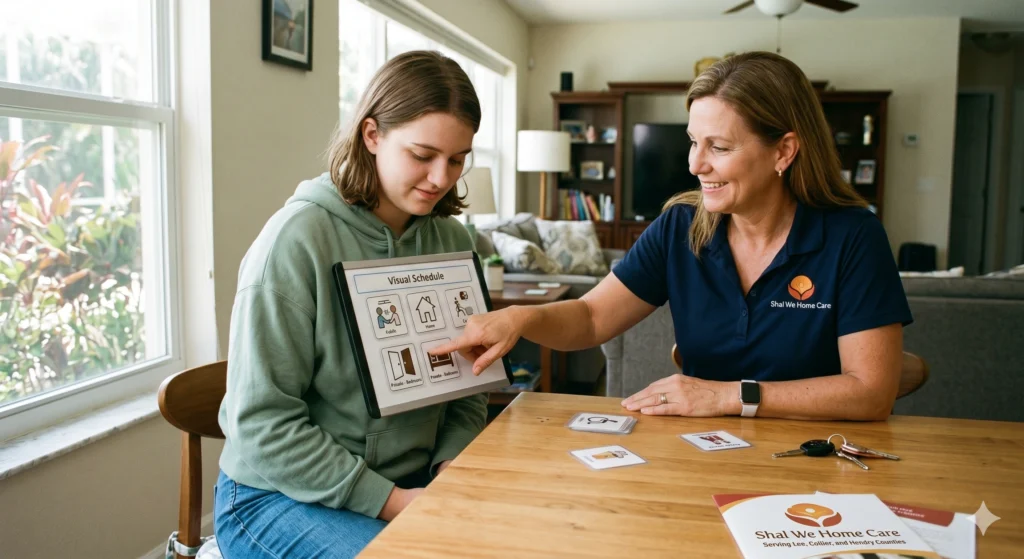
As your child grows into an adult body, having a parent assist them with showering or toileting can become awkward and inappropriate, causing severe behavioral resistance.
At Shal We Home Care, serving Lee, Collier, and Hendry counties, we provide specialized respite and personal care for neurodivergent teens and young adults.
- Preserving Dignity: Having a professional, objective caregiver assist with bathing and hygiene routines preserves the teen’s dignity and establishes healthy boundaries away from their parents.
- Reinforcing Rules: Our caregivers are trained to enforce the “public vs. private” rules consistently, using the exact same language and visual schedules you use, ensuring the lessons stick.
- Be Literal: Abstract concepts don’t work. Explicitly define what rooms are “private” and what behaviors must happen behind a closed door.
- Use Visuals: Break new hygiene routines (showering, deodorant, shaving) down into step-by-step visual charts.
- Simplify Menstruation: Practice using pads before puberty begins, or switch to absorbent period underwear to reduce sensory and motor skill hurdles.
- Teach Consent: Allow your teen to say “no” to physical affection to teach them bodily autonomy.
- Use Clinical Terms: Teach correct anatomical names for body parts to empower them against potential abuse.
Are you struggling with the transition into puberty? You don’t have to navigate these challenging years alone.
Contact Shal We Home Care today. Let our specialized caregivers help you establish healthy, dignified hygiene routines for your growing teen.